By Lauren Holland
Updated November 2026
Shopping for a portable car battery charger Stanley makes is easier when you know what you actually need. This guide compares four Stanley models that cover the most common situations: a dead battery in a daytime parking lot, a vehicle that sits for weeks, a garage with a trickle-charge habit, and a bigger truck or RV. Each pick is judged on peak amperage, portability, whether it can charge the battery itself or only jump-start it, and the extras owners tend to rely on, such as USB ports and built-in inflators.
Note on the selection method: the comparisons below are based on published specifications, brand reputation, and patterns in owner feedback. None of these units were tested by the author.
Our top picks at a glance
- 1
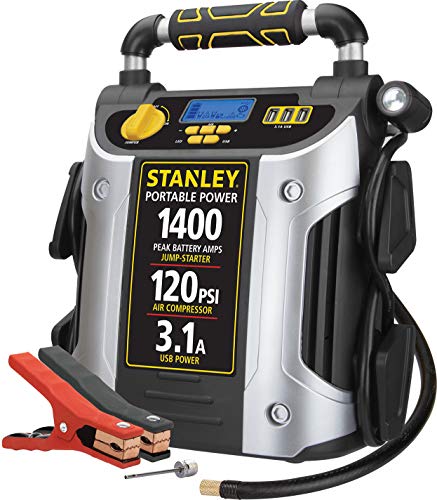 TOP CHOICEBest overallStanley J7C09D 1400 Peak Amp Jump Starter with 120 PSI InflatorView on Amazon
- 2
 Best for larger vehiclesStanley J509 1000 Peak Amp Jump Starter for VehiclesView on Amazon
- 3
 Best for compact useSTANLEY J309 600 Amp Jump StarterView on Amazon
- 4
 Best for battery maintenanceStanley BM1S 1 Amp Battery ChargerView on Amazon
Our Top Picks
Quick Comparison
| Product | Best for | Key feature |
|---|---|---|
| Stanley J7C09D 1400 Peak Amp Jump Starter | Gas and diesel cars, trucks, and SUVs | 1400 peak amps with a 120 PSI inflator |
| STANLEY J309 600 Amp Jump Starter | Compact cars and motorcycles | Lightweight build with USB ports |
| Stanley J509 1000 Peak Amp Jump Starter | Mid-size trucks and SUVs | 12V DC outlet for powering accessories |
| Stanley BM1S 1 Amp Battery Charger | Keeping seasonal vehicles charged | Slow 1 amp output for long-term maintenance |
Stanley J7C09D 1400 Peak Amp Jump Starter with 120 PSI Inflator
Stanley J7C09D 1400 Peak Amp Jump Starter with 120 PSI Inflator | For 4, 6 and 8-cylinder Gas and Diesel Cars, Trucks, Motorcycles, SUV's, Boats, ATV's, and RV's, USB charging and LED Light
Best for: Drivers who want one unit that handles a dead battery and a low tire.
This is the most versatile model in the lineup. It is listed for 4, 6, and 8-cylinder gas and diesel vehicles, along with trucks, SUVs, motorcycles, boats, ATVs, and RVs. Owners who keep a single jump starter in the trunk often value the combination of jump-start power and an inflator that can handle a tire at 120 PSI.
Key specs
- 1400 peak amps
- 120 PSI built-in inflator
- USB charging ports
- Built-in LED light
Pros
- Covers a wide range of engine sizes and vehicle types
- Inflator reduces the need for a second tool in the trunk
- USB and LED light add everyday usefulness
Cons
- Larger footprint than compact jump starters
- Inflator performance on large tires takes patience
Bottom line: The best choice for a driver who wants one unit covering jump-starting and tire emergencies across several vehicle types.
View on AmazonSTANLEY J309 600 Amp Jump Starter
STANLEY J309 600 Amp Jump Starter | Portable Power Station 3.1A USB Ports
Best for: Small cars, motorcycles, and anyone who wants a compact unit that fits in a glove box.
The J309 is the lightest option here and is aimed at smaller engines. It suits a commuter car or motorcycle where storage space is limited and the typical job is a single jump start after a cold night.
Key specs
- 600 amp rating
- 3.1A USB ports
Pros
- Compact and easy to store
- USB ports for charging phones during a wait
- Straightforward operation for first-time users
Cons
- Limited headroom for larger V8 engines
- Fewer extras than the higher-amp models
Bottom line: A sensible pick for a smaller vehicle when portability matters more than peak power.
View on AmazonStanley J509 1000 Peak Amp Jump Starter for Vehicles
Stanley J509 1000 Peak Amp Jump Starter for Vehicles | Portable Power Station with USB Ports and 12V DC Outlet
Best for: Mid-size trucks and SUVs, and drivers who want a 12V outlet for accessories.
The J509 sits between the compact and high-output models. Its 12V DC outlet makes it useful at a campsite or job site, where you may need to run a small appliance or tool as well as jump a vehicle.
Key specs
- 1000 peak amps
- USB ports
- 12V DC outlet
Pros
- Good middle ground between power and size
- 12V outlet adds utility beyond jump-starting
- USB ports for phones and small devices
Cons
- Less capable than the 1400-amp model for heavy-duty engines
- Does not include an air compressor
Bottom line: A strong choice for mid-size vehicles and anyone who values a 12V outlet at camp or on a job site.
View on AmazonStanley BM1S 1 Amp Battery Charger
Stanley BM1S 1 Amp Battery Charger for Vehicles | Keeps 12V Batteries Charged Up
Best for: Keeping a stored vehicle, motorcycle, or lawn tractor battery topped off.
This is a different kind of tool. It does not jump-start anything. It is a slow charger meant to keep a 12V battery healthy between uses, which is useful for a vehicle parked for weeks or a seasonal machine.
Key specs
- 1 amp charging output
- Designed for 12V batteries
Pros
- Slow, steady output is gentler on batteries over long periods
- Good for maintenance rather than emergencies
- Simple to use for occasional owners
Cons
- Far too slow for a dead battery that needs a quick start
- Not a jump starter and not a portable power source
Bottom line: The right tool for keeping a battery alive in storage, but not a substitute for a jump starter.
View on AmazonBuying Guide
Peak amps versus cranking power
Peak amps are a marketing-friendly number, and the rating is measured under ideal conditions. For a gas engine with four or six cylinders, a unit in the 600 to 1000 amp range is usually enough. Larger V8 engines, diesels, and cold climates call for more headroom. Look for the engine size your unit is rated for, not just the headline number.
Good picks for this: Stanley J7C09D 1400 Peak Amp Jump Starter, Stanley J509 1000 Peak Amp Jump Starter
Jump starter versus battery charger
A jump starter stores energy and delivers a burst of current to crank the engine. A battery charger, such as a 1 amp maintainer, replenishes a battery slowly over hours. They solve different problems. If you need to get moving now, you want a jump starter. If a vehicle sits unused, a maintainer is the better fit.
Good picks for this: Stanley BM1S 1 Amp Battery Charger, Stanley J309 600 Amp Jump Starter
Size and storage
A unit that lives in a trunk or under a seat should be light enough to lift with one hand and small enough to fit a spare-tire well. Compact models are easier to store, but larger units often carry more power and extra features. Decide where the unit will live before you choose.
Good picks for this: STANLEY J309 600 Amp Jump Starter, Stanley J509 1000 Peak Amp Jump Starter
Built-in inflator
An integrated air compressor saves space if you want one tool for two emergencies. Check the stated PSI rating and remember that inflating a large tire takes longer than topping off a small one. Owners often report that inflators are best for correcting a low tire and reaching a service station, not for full inflation of a truck tire.
Good picks for this: Stanley J7C09D 1400 Peak Amp Jump Starter
USB and 12V outlets
USB ports help keep a phone charged while you wait for a tow. A 12V outlet lets you power a small pump, cooler, or lamp. Check the stated output on each port and whether the outlet is intended for accessories rather than high-draw appliances.
Good picks for this: Stanley J509 1000 Peak Amp Jump Starter, STANLEY J309 600 Amp Jump Starter
Battery safety and polarity
Always connect clamps in the correct order, positive first and negative last, and keep the unit upright and away from sparks. Follow the manufacturer’s instructions for your specific model. If you are unsure about a battery that is swollen, cracked, or leaking, stop and consult a professional mechanic.
Good picks for this: Stanley J7C09D 1400 Peak Amp Jump Starter, Stanley BM1S 1 Amp Battery Charger
Durability and care
Keep the unit charged, store it in a cool, dry place, and recharge it periodically even if you have not used it. Heat and deep discharge shorten battery life. Owners who follow a simple schedule often find their unit holds a charge far better than one left empty in a hot trunk.
Good picks for this: Stanley BM1S 1 Amp Battery Charger, Stanley J509 1000 Peak Amp Jump Starter
FAQ
Can a Stanley portable car battery charger jump-start any vehicle?
Not every model can. The jump starters here are rated for different engine sizes. Check the stated vehicle types and engine cylinder count before buying. The BM1S is a maintainer and cannot jump-start a vehicle.
How long does a jump starter stay charged?
It depends on storage conditions and battery age. Many owners recharge their unit every few months to keep it ready. Consult the manual for the recommended schedule for your model.
Is a 1 amp charger fast enough for a dead battery?
No. A 1 amp charger is designed for slow, long-term maintenance. For a dead battery that needs to start the engine now, a jump starter is the better tool.
Can I use a jump starter to inflate tires?
Models with a built-in inflator can. The J7C09D lists a 120 PSI inflator. Inflating a large tire takes longer than a small one, so plan accordingly.
What should I do if the unit will not turn on?
Confirm it is charged, check the cable and clamp connections, and review the troubleshooting section of the manual. If the problem persists, contact the manufacturer or a qualified technician.
Are the USB ports good for charging a laptop?
USB ports are generally suited to phones and small devices. Check the stated output before relying on them for a laptop.
Conclusion
For most drivers, the Stanley J7C09D 1400 Peak Amp Jump Starter offers the widest coverage, especially if you want an inflator in the same unit. The Stanley J509 suits mid-size trucks and anyone who needs a 12V outlet. The STANLEY J309 is the practical choice for a compact car or motorcycle. The Stanley BM1S is not a jump starter, but it is the right tool for keeping a stored battery healthy. Match the tool to the job, and you will get the most from a portable car battery charger Stanley offers.
For related reading, see Vehicle Jump Starters Portable Car Battery Charger: How to Choose and Use One, Portable Electric Car Battery Charger: 4 Best Picks for Every Need (2026), and Portable Car Battery Charger with Air Compressor: A Practical Guide (2026).
Sources
- Guidance on battery types, charging behavior, and energy storage basics (energy.gov)
- Consumer safety information on lithium and battery-powered products (cpsc.gov)
- Vehicle safety guidance, including battery and roadside emergency advice (nhtsa.gov)
Related reading
- Small Portable Car Battery Charger: How to Choose and Use One Safely
- Portable Battery Charger for Car and Phone: How to Choose and Use One Safely
About Lauren Holland
Lauren Holland is part of our editorial team and reviews and edits our car care & garage supplies guides, checking product details against manufacturer specifications and owner feedback.