By Lauren Holland
Updated November 2026
The best tire inflator and battery charger for most drivers is a compact unit with an accurate pressure gauge, enough current to reach your tire’s target PSI without overheating, and a charger that can handle your battery’s type and size. This guide walks you through what to check before you buy, how to use a combined unit safely, and the mistakes that cause most problems.
Step 1: Confirm the Pressure and Battery Specs You Need
Start with your vehicle, not the product listing. The tire placard on the driver’s door jamb lists the recommended cold pressure, usually between 30 and 36 PSI for passenger cars. Your battery’s specs are printed on its label: look for the voltage (almost always 12V for passenger vehicles) and the amp-hour rating. A trickle charger or maintainer is built for low current over long periods, while a full charger delivers more amps for faster recovery.
Shopping for one? See our guide: 4 Best Milwaukee Portable Tire Inflators of 2026 Compared.
Step 2: Evaluate the Inflator Side
Focus on three things. First, the maximum pressure rating should comfortably exceed your tire’s target PSI, since most passenger tires need 35 PSI or less. Second, check the duty cycle, which tells you how long the compressor can run before it must rest. Manufacturers often specify a short run time followed by a cool-down, so inflating a large truck or SUV tire from flat will take patience. Third, look for a digital gauge with auto-shutoff. Auto-shutoff lets you set a target and stop the compressor automatically, which prevents overinflation.
Step 3: Evaluate the Charger Side
Match the charger’s output to your battery. A higher amp rating charges faster but generates more heat and can shorten the life of a small battery if left connected too long. Look for automatic float or maintenance mode, which stops or reduces charging once the battery is full. Reverse-polarity and short-circuit protection are standard on quality units and should be confirmed in the manufacturer’s documentation.
Step 4: Use the Combined Unit Safely
- Park on level ground, turn the engine off, and set the parking brake.
- Connect the charger clamps to the battery, red to positive and black to a solid chassis ground or the negative terminal, following the manual.
- Start the charger and confirm it reads the battery correctly before walking away.
- Once charging is complete, disconnect the charger before using the inflator, unless the manual says the unit is safe to run both at once.
- Check tire pressure cold, set the target on the inflator, and inflate in short bursts, rechecking as you go.
- Let the compressor cool between tires if the manual calls for it.
Comparison at a Glance
| Feature | What to Look For | Why It Matters |
|---|---|---|
| Max inflator PSI | Above your tire’s target PSI | Lets you reach spec without strain |
| Duty cycle | Clearly stated in the manual | Prevents compressor overheating |
| Charger amp rating | Matched to your battery size | Avoids overcharging small batteries |
| Auto shutoff / maintenance mode | Present on both functions | Reduces overinflation and overcharging |
If you are still deciding between formats, Car Battery Charger with Tire Inflator: Setup, Uses and Limits (2026) covers how these combined units differ in practice. For a battery-powered inflator on its own, Tire Inflator Battery Powered: How to Choose and Use One (Step-by-Step) goes deeper on runtime and pressure accuracy.
Common Mistakes
- Inflating tires while they are hot from driving, which gives a falsely high reading.
- Ignoring the duty cycle and running the compressor until it overheats.
- Leaving a standard (non-maintenance) charger connected for days.
- Connecting the negative clamp to the battery terminal while charging, which can spark near hydrogen gas.
- Trusting an unverified gauge. Compare it against a known reference gauge once in a while.
Recommended Gear
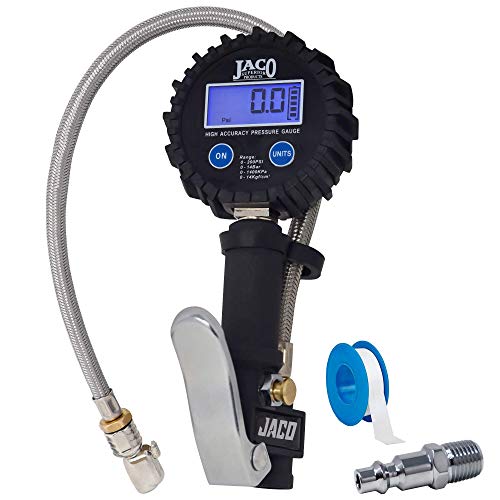
A reliable handheld gauge is useful for double-checking the inflator’s readout. Search for a digital tire pressure gauge with a backlit display. View on Amazon
A battery maintainer is the right tool if the car sits for long stretches, since it keeps the battery topped without overcharging. View on Amazon
A portable 12V tire inflator with auto shutoff covers roadside inflation and pairs well with a separate charger for a complete setup. View on Amazon
FAQ
Can I run a tire inflator and battery charger at the same time?
Only if the manual for your specific unit says it is safe. In most cases, disconnect the charger first to avoid drawing extra current from the battery and to keep the cables clear of moving parts.
What PSI should I set my tires to?
Use the pressure listed on the tire placard in your driver’s door jamb, not the maximum printed on the tire sidewall. Check it when the tires are cold.
How do I know if a charger is overcharging my battery?
Watch for a battery that feels hot, a case that is swollen, or a strong rotten-egg smell. If you see any of these, disconnect the charger and have the battery inspected by a qualified technician.
Conclusion
The best tire inflator and battery charger for your car matches your tire’s target PSI, your battery’s voltage and amp-hour rating, and a duty cycle you can live with. Confirm those specs first, then use the unit in the order described above. Following the steps and avoiding the common mistakes will keep both your tires and your battery in good shape.
Related reading
Ready to choose one?
About Lauren Holland
Lauren Holland is part of our editorial team and reviews and edits our car care & garage supplies guides, checking product details against manufacturer specifications and owner feedback.