This post contains Amazon affiliate links. As an Amazon Associate I earn from qualifying purchases, at no extra cost to you.
Keeping your tires at the correct pressure improves safety, fuel economy, and tread life. A reliable tire pressure gauge helps you check inflation quickly and accurately. Whether you prefer a classic analog dial, a simple pencil gauge, or a digital model with extra functions, the best tire pressure gauge for you depends on the vehicles you drive and how you use it.
We selected five tire pressure gauges by comparing the specifications and features listed by the manufacturers. We have not tested these products ourselves. Check each product listing for current prices, availability, and customer reviews before buying.
Our Picks at a Glance
We chose these five tire pressure gauges by comparing listed specs: measurement range, accuracy claims, build materials, included features (bleeder valve, swivel chuck, backlight, deflator), and warranty terms. The selection covers analog dial, pencil, and digital types to suit different needs. No product was tested by us. For the latest price and rating, refer to each product’s listing page.


The Five Picks in More Detail
JACO ElitePro Tire Pressure Gauge: Best for precision analog reading
The JACO ElitePro is an analog dial gauge with a 60 PSI range. It is built with solid brass and a shock-resistant gear-style protective guard. The 2-inch glow dial locks the reading in place until you press the reset button. A built-in air bleeder valve lets you reduce pressure in overinflated tires, and the 360-degree swivel chuck makes it easy to reach awkward valve stems. The gauge is calibrated at an ANSI-accredited facility and is claimed to be accurate within ±1.5% of ANSI standards. JACO backs it with a 100% lifetime warranty.
Specs that matter: Type: analog dial; Range: 0–60 PSI; Accuracy: ±1.5% (ANSI); Bleeder valve: yes; Swivel chuck: yes; Dial illumination: glow-in-the-dark; Materials: brass, with protective guard; Warranty: lifetime.
Best for: Drivers who want a rugged analog gauge with a bleeder valve and a lock-in reading feature for precise tire pressure adjustments.
AstroAI Pencil Tire Pressure Gauge: Best for compact glove-box storage
The AstroAI Pencil Tire Pressure Gauge comes in a 2-pack. Each gauge has a stainless steel body to resist rust and corrosion. It measures in PSI (10–75), kPa, and BAR. The precision-crafted nozzle is designed to seal onto valve stems for readings within ±2% of span (Grade B per ANSI B40.1). An integrated deflator valve allows you to release air, and a pocket clip makes it easy to carry. No batteries are required. Four valve stem caps are included.
Specs that matter: Type: pencil; Range: 10–75 PSI (also kPa, BAR); Accuracy: ±2% of span (ANSI B40.1 Grade B); Bleeder/deflator: yes; Pocket clip: yes; Materials: stainless steel; Batteries: none; Included: 2 gauges, 4 valve stem caps.
Best for: Drivers who want a simple, battery-free gauge that stores in a glove box or pocket, and who need a backup or a second gauge for another vehicle.
ETENWOLF T300 Digital Tire Pressure Gauge: Best for wide pressure range and durability
The ETENWOLF T300 is a digital gauge that measures from 3 to 200 PSI. It is manually calibrated to ANSI B40.7 Grade 2A (accuracy of ±0.5% or ±1 PSI). An internal AI chip with thermal compensation maintains accuracy in extreme temperatures from -4°F to 130°F. The gauge is built to survive being run over by a car. It has a replaceable AAA battery (included) and an LED light for reading in dark areas. Note: a Presta valve adapter is not included and must be purchased separately for bicycle use.
Specs that matter: Type: digital; Range: 3–200 PSI; Accuracy: ±0.5% (ANSI B40.7 Grade 2A); Temperature compensation: yes; Backlight: LED; Battery: replaceable AAA (2 included); Durability: run-over resistant; Warranty: 3 years.
Best for: Owners of cars, trucks, RVs, and bikes who need a wide pressure range and a gauge that can handle harsh conditions without losing accuracy.
TireTek Tire Pressure Gauge: Best for easy-grip analog dial with swivel chuck
The TireTek analog dial gauge has a 60 PSI range and is calibrated to ANSI B40.1 Grade B (2%) accuracy. It features a steel and brass construction with a rubber cover for drop protection and grip. The 45-degree angled, fully swiveling chuck helps reach valve stems at awkward angles. A built-in relief (bleed) button lets you release air while the gauge remains on the valve. The glow-in-the-dark dial makes readings visible in low light. No batteries are required.
Specs that matter: Type: analog dial; Range: 0–60 PSI; Accuracy: ANSI B40.1 Grade B (2%); Swivel chuck: yes, 45° angled; Bleeder valve: yes; Dial illumination: glow-in-the-dark; Materials: steel, brass, rubber cover; Batteries: none.
Best for: Drivers who want a durable analog gauge with a rubber grip, a swivel head, and a built-in bleeder for easy pressure adjustment.
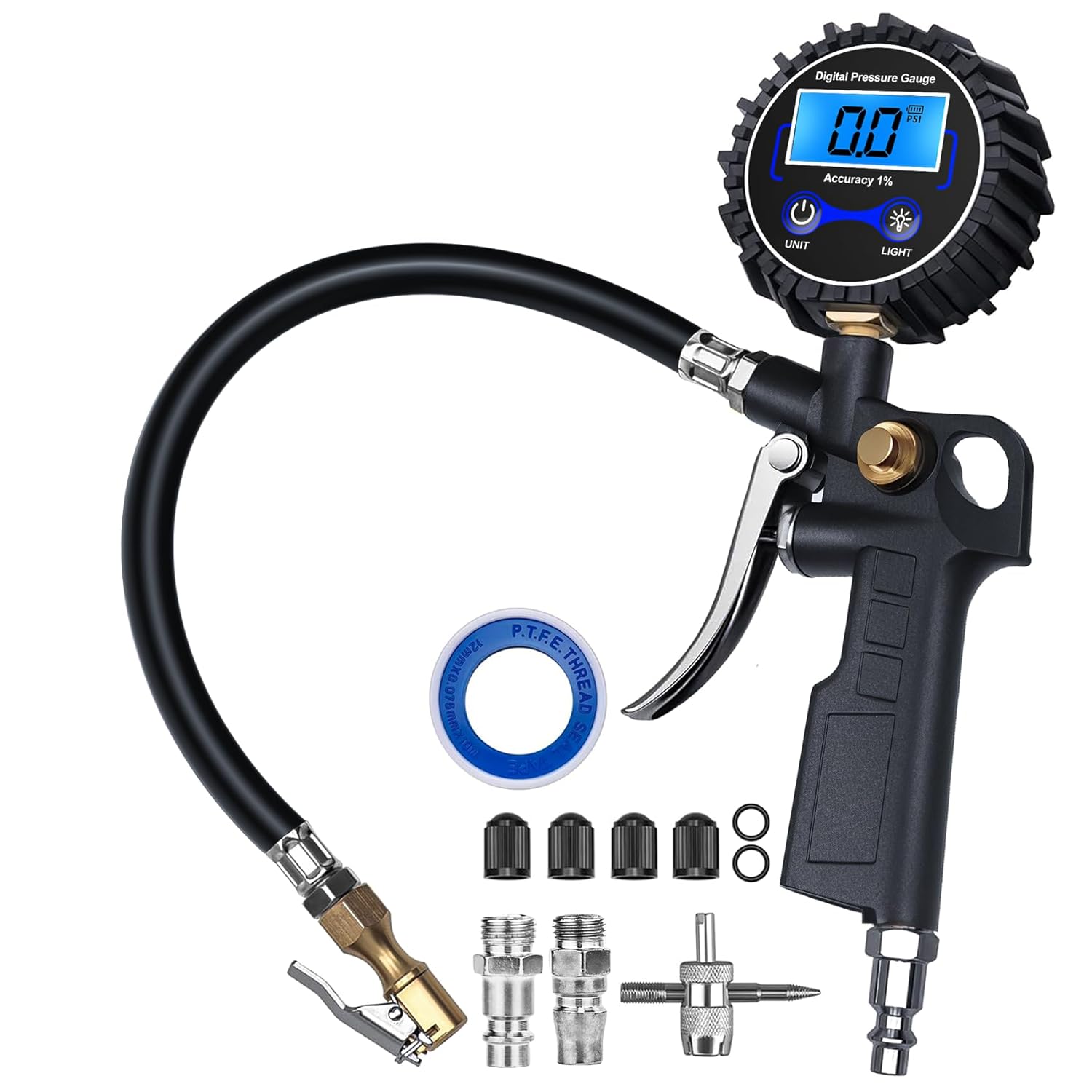
DigitPro Digital Tire Pressure Gauge with Inflator: Best for 3-in-1 check, inflate, and deflate
The DigitPro Digital Tire Pressure Gauge combines checking, inflation, and deflation in one tool. It measures from 3 to 250 PSI with a resolution of 0.1 PSI and an accuracy within 1%. The unit displays PSI, KPA, BAR, and KG/CM². It connects to ½-inch and ¼-inch NPT air compressors for inflation. The gauge is made of heavy-duty stainless steel and brass with a rubber hose and a gear-type rubber dial. The LCD display has a light mode for night use. It is backed by a 3-year warranty.
Specs that matter: Type: digital with inflator; Range: 3–250 PSI; Accuracy: within 1%; Resolution: 0.1 PSI; Units: PSI, KPA, BAR, KG/CM²; Inflator compatibility: ½” and ¼” NPT air compressors; Deflator: yes; Backlight: yes; Materials: stainless steel, brass, rubber hose; Warranty: 3 years.
Best for: Those who work with air compressors and want a single tool to check, inflate, and deflate tires for trucks, cars, SUVs, and RVs.
How to Choose
Type: Analog vs. Digital
Analog gauges (dial or pencil) require no batteries and are generally more durable in extreme temperatures. Dial gauges often include features like bleeder valves and glow-in-the-dark faces. Pencil gauges are compact and inexpensive but can be harder to read precisely. Digital gauges offer higher resolution (often 0.1 PSI) and can measure a wider range of pressures, but they rely on batteries. Some digital models include backlights for dark conditions and thermal compensation for accuracy in cold or heat.
Pressure Range
Your vehicle’s recommended pressure is printed on the tire placard (usually on the driver’s door jamb) and in the owner’s manual; trucks, RVs, and some motorcycles may need higher pressures than passenger cars. Choose a gauge whose maximum PSI exceeds your vehicle’s recommended pressure. A gauge with a range of 60 PSI covers most cars and light trucks; a 200 or 250 PSI gauge is needed for heavy-duty applications.
Accuracy and Standards
Manufacturers often cite ANSI standards. For analog gauges, ANSI B40.1 Grade B (±2%) is common; some claim Grade A or better. For digital gauges, ANSI B40.7 Grade 2A (±0.5% or ±1 PSI) is a high accuracy level. Lower numbers indicate tighter tolerance. Check the product listing for the specific accuracy claim and the standard referenced.
Extra Features
A bleeder valve lets you release air to reach the target pressure without removing the gauge. A swivel chuck makes it easier to access angled valve stems. Some digital gauges include an inflator function that connects to an air compressor. A backlight or glow dial helps in low light. If you carry the gauge with you, a pocket clip or compact size is useful.
Build Quality
Materials like brass, stainless steel, and protective rubber covers can improve durability. Some gauges are rated as run-over resistant. A warranty (lifetime or multi-year) indicates the manufacturer’s confidence.
Comparison Table
| Product | Type | Range (PSI) | Accuracy Claim | Bleeder Valve | Swivel Chuck | Backlight/Glow | Warranty |
|---|---|---|---|---|---|---|---|
| JACO ElitePro | Analog dial | 0–60 | ±1.5% (ANSI) | Yes | Yes, 360° | Glow dial | Lifetime |
| AstroAI Pencil (2-pack) | Pencil | 10–75 | ±2% span (ANSI B40.1 Grade B) | Integrated deflator | No | None | Not listed |
| ETENWOLF T300 | Digital | 3–200 | ±0.5% (ANSI B40.7 Grade 2A) | No (deflator not specified) | Not listed | LED | 3 years |
| TireTek | Analog dial | 0–60 | ANSI B40.1 Grade B (2%) | Yes | Yes, 45° angled | Glow dial | Not listed |
| DigitPro Digital with Inflator | Digital with inflator | 3–250 | Within 1% | Yes (deflator) | Not listed | LCD light mode | 3 years |
FAQ
What PSI range do I need for my car?
Check the tire placard for your vehicle’s recommended pressure. Check the sticker on your driver’s door jamb or your owner’s manual. A gauge with a 60 PSI range covers this comfortably. For trucks or RVs, a higher range (200+ PSI) may be necessary.
Are digital gauges more accurate than analog?
Digital gauges often have higher resolution (0.1 PSI) and can meet tighter accuracy standards (e.g., ±0.5%). However, many high-quality analog gauges are also accurate within ±1–2%. Both types work well if properly calibrated.
Do I need a gauge with a bleeder valve?
A bleeder valve is helpful if you tend to overinflate. It lets you release air without removing the gauge, saving time. If you use an air compressor with a shut-off feature, a bleeder is less essential.
Can I use a tire pressure gauge on a bicycle?
Some gauges work with Schrader valves (common on cars and many bikes). For Presta valves, you may need an adapter. The ETENWOLF T300 listing notes that a Presta valve adapter is not included and must be purchased separately. Check your valve type before buying.
Choosing the best tire pressure gauge comes down to matching the gauge’s range, accuracy, and features to the vehicles you drive and your preferred checking method. For more guidance on proper tire maintenance, see our articles on how to check tire pressure the right way and how to inflate tires with a portable inflator. Regular pressure checks also help you know when to replace car tires based on wear patterns.