By Lauren Holland
Updated November 2026
A car battery charger and tester combines two jobs in one box: it measures whether your battery still holds a healthy charge, and then it refills or repairs it if it doesn’t. For a home mechanic, that combination saves guesswork. Instead of wondering whether a sluggish start means a dead battery, a failing alternator, or a bad cable, you can check the battery first and decide what to do next. This guide looks at three units from the same product family, chosen on four criteria: built-in battery and charging-system testing, number of charging modes, support for both 12V and heavier-duty use, and clear, consistent owner feedback about setup and reliability.
Our top picks at a glance
- 1
 TOP CHOICEBest overallFOXWELL BC521 2-in-1 Battery Charger & Tester, Test Before Charging 12V 5AView on Amazon
- 2
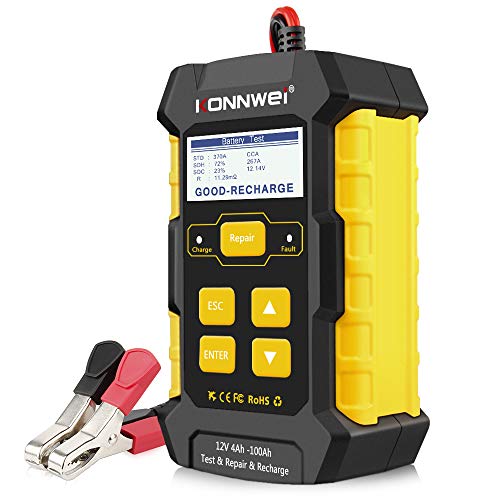 Best for a versatile all-in-one setupKONNWEI 3 in 1 Car Battery Charger, KW510 Battery Tester 12V 5-Amp FulView on Amazon
- 3
 Best for higher-amperage and 24V workKONNWEI KW520 3-in-1 Car Battery Tester Charger 12V 24V 10A/5A Pulse RepairView on Amazon
Our Top Picks
| Product | Best for | Key feature |
|---|---|---|
| FOXWELL BC521 2-in-1 Battery Charger & Tester | Testing before charging on a 12V battery | Tests battery health, cranking, and alternator output before an 8-stage charge |
| KONNWEI KW510 3 in 1 Car Battery Charger | Routine maintenance and battery recovery | 5A fully automatic charging with pulse repair and desulfation modes |
| KONNWEI KW520 3-in-1 Car Battery Tester Charger | Larger batteries and 24V systems | Switchable 12V 10A and 24V 5A charging with a built-in tester |
FOXWELL BC521 2-in-1 Battery Charger & Tester, Test Before Charging 12V 5A
FOXWELL BC521 2-in-1 Battery Charger & Tester, Test Before Charging 12V 5A | Test Car Battery Health, Cranking and Alternator Output, Then Use 8-Stage Charging, Pulse Repair Or Battery Maintenance
Best for: Testing before charging on a 12V battery
This is the most straightforward fit for someone who wants a clear diagnostic step before any charging begins. It suits a home garage owner who regularly deals with slow cranking and wants to know whether the battery, the starter circuit, or the charging system is responsible.
Key specs
- 12V battery system
- 5A charging output
- Battery health, cranking, and alternator output testing
- 8-stage charging, pulse repair, and maintenance modes
Pros
- Testing comes first, so you know whether charging will actually help
- Covers the charging system as well as the battery itself
- Multi-stage charging suits a range of lead-acid batteries
Cons
- A 5A output is slow for a deeply discharged battery
- Limited to 12V, so it is not a fit for 24V equipment
Bottom line: Pick this if your main goal is diagnosing a weak battery or alternator before deciding whether to charge.
View on AmazonKONNWEI 3 in 1 Car Battery Charger, KW510 Battery Tester 12V 5-Amp Fully Automatic Smart Charger
KONNWEI 3 in 1 Car Battery Charger, KW510 Battery Tester 12V 5-Amp Fully Automatic Smart Charger Automotive Pulse Repair Maintainer, Trickle Charger Battery Desulfator w/Temp Compensation
Best for: Routine maintenance and battery recovery
This unit fits owners who keep a seasonal vehicle, a motorcycle, or a lawn tractor battery topped up and want an automatic charger that also carries a tester and a desulfation option.
Key specs
- 12V battery system
- 5A fully automatic charging
- Pulse repair and trickle maintainer modes
- Temperature compensation
Pros
- Fully automatic operation reduces the need to monitor it
- Pulse repair mode is useful for batteries that have lost capacity from sulfation
- Maintainer mode suits long storage periods
Cons
- Desulfation results vary; a badly damaged battery may not recover
- Owners sometimes report that the tester is less detailed than dedicated diagnostic units
Bottom line: A good all-around choice for a home garage that needs charging, maintenance, and a basic health check in one box.
View on AmazonKONNWEI KW520 3-in-1 Car Battery Tester Charger 12V 24V 10A/5A Pulse Repair
KONNWEI KW520 3-in-1 Car Battery Tester Charger 12V 24V 10A/5A Pulse Repair | Test Automotive Battery Health, Cranking & Charging, Then 12V 10A / 24V 5A Charge, Pulse Repair & Smart Trickle Maintainer
Best for: Higher-amperage and 24V work
This model suits owners who work with larger batteries, heavy vehicles, or equipment that runs on a 24V system and who want faster charging than a 5A unit can provide.
Key specs
- 12V 10A and 24V 5A charging settings
- Built-in battery and charging-system tester
- Pulse repair and smart trickle maintainer modes
Pros
- Higher 12V output shortens charge time on larger batteries
- Covers both 12V and 24V systems in one unit
- Tester and charger in a single housing
Cons
- Higher output needs more care with clamp connections and cable sizing
- Overkill for a small motorcycle or lawn mower battery
Bottom line: Choose this if you need faster charging or 24V capability and are comfortable with a more powerful charger.
View on AmazonBuying Guide
Built-in testing functions
A tester that checks battery health, cranking capacity, and alternator output tells you what is wrong before you charge. Without that step, you can spend hours charging a battery that will not hold a charge. Look for a unit that reports both battery state and charging-system output.
Good picks for this: FOXWELL BC521 2-in-1 Battery Charger & Tester, KONNWEI KW520 3-in-1 Car Battery Tester Charger
Voltage compatibility
Most passenger cars use a 12V battery, while many trucks, buses, and some marine or industrial systems use 24V. Confirm your system voltage before buying. A 12V-only charger is fine for a sedan, but it will not work on a 24V truck battery.
Good picks for this: KONNWEI KW520 3-in-1 Car Battery Tester Charger, KONNWEI KW510 3 in 1 Car Battery Charger
Charging amperage
Lower-amperage chargers, around 2A to 5A, are gentler and suit maintenance. Higher amperage, such as 10A, shortens charge time on larger batteries. Match the output to your battery size and how much time you have. Heavy amperage on a small battery can cause overheating.
Good picks for this: KONNWEI KW510 3 in 1 Car Battery Charger, KONNWEI KW520 3-in-1 Car Battery Tester Charger
Charging modes
Look for multi-stage charging, pulse repair, and a trickle or maintainer mode. Multi-stage charging protects the battery through bulk, absorption, and float phases. Pulse repair may help recover a battery with light sulfation, though results depend on how damaged the plates are.
Good picks for this: FOXWELL BC521 2-in-1 Battery Charger & Tester, KONNWEI KW510 3 in 1 Car Battery Charger
Use case and storage
If you are charging a car that is parked for months, a maintainer mode matters more than raw amperage. If you are reviving a dead battery after a bad winter, a higher-output mode with a clear tester is more useful. Think about how often you will use the unit and for what kind of battery.
Good picks for this: KONNWEI KW510 3 in 1 Car Battery Charger, KONNWEI KW520 3-in-1 Car Battery Tester Charger
Durability and clamp quality
Clamps and cables take the most wear. Look for insulated clamps, a sturdy housing, and cable strain relief. Check that the charger has basic protection against reverse polarity and short circuits, which manufacturers typically describe as standard safety features on modern units.
Good picks for this: FOXWELL BC521 2-in-1 Battery Charger & Tester, KONNWEI KW520 3-in-1 Car Battery Tester Charger
Care and safe handling
Charge in a ventilated area, because lead-acid batteries can release hydrogen during charging. Keep sparks and open flames away, disconnect the charger before attaching or removing clamps where the manual advises, and inspect cables regularly. If you are unsure about a battery that is swelling, leaking, or damaged, consult a professional before charging.
Good picks for this: KONNWEI KW510 3 in 1 Car Battery Charger, FOXWELL BC521 2-in-1 Battery Charger & Tester
FAQ
Can a car battery tester and charger tell me if my alternator is bad?
Some units measure charging-system output as well as battery health. If the reading at the battery terminals is well below what the manufacturer specifies while the engine runs, the alternator or its wiring may be at fault. A reading alone does not confirm the cause, so a professional check is worthwhile if the result is unclear.
How do I know if a battery is worth charging?
Test it first. If the tester reports the battery as failed or unable to hold a charge, charging may not restore it. Batteries that are very old, swollen, or leaking should be replaced rather than charged.
Is it safe to leave a charger connected overnight?
Smart or maintainer modes are designed to stop or reduce output once the battery is full, which makes overnight use common. Still, charge in a ventilated space and follow the manual. Avoid leaving any charger connected to a damaged battery.
What amperage should I use?
Lower amperage, such as 2A to 5A, is gentler and suits maintenance and slow recovery. Higher amperage shortens charge time but produces more heat. Match the setting to your battery size and the manufacturer’s recommendation.
Can I use a 12V charger on a 24V battery?
No. A 12V-only unit will not safely charge a 24V battery. Use a charger rated for 24V, or a model that offers both settings, if your system uses that voltage.
Does pulse repair always restore a dead battery?
No. Pulse repair may help with light sulfation, but a battery with internal damage, dried-out cells, or a shorted cell will not recover fully. Test the battery afterward to see whether the change is meaningful.
Should I disconnect the battery before charging?
Many manuals recommend disconnecting the battery from the vehicle first, especially on modern cars with sensitive electronics. Check your vehicle manual and charger instructions before you start.
Conclusion
All three units combine testing and charging, but they suit different needs. The FOXWELL BC521 is the most diagnosis-focused option, useful when you want to confirm the battery and charging system before charging. The KONNWEI KW510 works well as a versatile, mostly automatic unit for maintenance and recovery. The KONNWEI KW520 fits owners who need higher 12V output or 24V capability. Match the tester depth, amperage, and voltage to your vehicle and how often you plan to use the charger.
Sources
- Guidance on lead-acid battery basics, charging, and safe handling (energy.gov)
- Consumer safety information on battery charging equipment and hazards (cpsc.gov)
- Workplace guidance on hydrogen gas and battery charging areas (osha.gov)
Related reading
- Solar Powered Car Battery Trickle Charger: 8 Best Picks for Every Need (2026)
- Solar Car Battery Charger: A Step-by-Step Guide for Beginners
- Solar Battery Trickle Charger for Car: 7 Best Picks for Every Need (2026)
About Lauren Holland
Lauren Holland is part of our editorial team and reviews and edits our car care & garage supplies guides, checking product details against manufacturer specifications and owner feedback.