Some links on this page are affiliate links. If you buy through them, we may earn a commission at no extra cost to you. As an Amazon Associate I earn from qualifying purchases. Learn more ›
USB-C Car Chargers: Wattage, Power Delivery and Two-Port Charging
A clear guide to USB-C car chargers covering Power Delivery, per-port wattage, laptop charging, cable quality, and fuse limits.
When you need to charge a phone, tablet, or even a laptop on the road, a USB-C car charger is often the best tool. But not all chargers work the same way. Understanding the difference between USB-A and USB-C ports, how Power Delivery (PD) affects charging speed, and how wattage splits between two ports helps you pick a charger that actually meets your needs. This guide explains the key points so you can choose a charger that fits your devices and your vehicle.
USB-A versus USB-C Ports
The type of port on a car charger determines how fast a device can charge and what kinds of cables you need. USB-A is the older, rectangular port that you have probably used for years. USB-C is the newer, oval-shaped port that is reversible and capable of much higher power delivery.
Most modern phones, tablets, and laptops rely on USB-C for fast charging. A USB-A port typically provides up to about 2.4 amps at 5 volts (roughly 12 watts), which is fine for a standard phone but too slow for a tablet or laptop. A USB-C port that supports Power Delivery can supply varying voltages and higher currents, allowing charging speeds many times faster than USB-A.
When shopping for a car charger, you will see models with one or more USB-C ports, or a mix of USB-A and USB-C. For charging newer devices quickly, a dedicated USB-C port with Power Delivery is essential. If you also need to charge older accessories, a USB-A port remains useful.
Feature
USB-A
USB-C (with Power Delivery)
Shape
Rectangular, non-reversible
Oval, reversible
Typical max power (car charger)
Up to 12W (5V / 2.4A)
Up to 100W or more (variable voltage)
Supports fast charging
Limited (proprietary fast-charge modes on some)
Yes (PD standard)
Best for
Older phones, basic accessories
Modern phones, tablets, laptops
Power Delivery and Fast Charging Basics
Power Delivery, often abbreviated as PD, is a charging protocol that allows a charger and a device to communicate and negotiate the highest safe voltage and current. Instead of always using 5 volts, a PD charger can output 9V, 12V, 15V, or even 20V depending on what the device requests. This allows a phone to charge from near empty to full in a fraction of the time compared to a standard 5V charger.
Not all USB-C ports support PD. If a charger has a USB-C port that is marked as PD, it can deliver fast charging. Some chargers also support proprietary fast-charge modes on USB-A ports, but PD is the most universal standard for USB-C devices, including most current phones, tablets and many laptops.
To use PD fast charging, you need a charger that supports PD and a cable that is rated for the wattage you expect. A standard USB-C cable may handle 60W, but a 100W PD charge requires an e-marked cable (discussed later).
Total Wattage versus Per‑Port Wattage
One of the most common misunderstandings about multi-port car chargers is the difference between the total wattage the charger can provide and the wattage allocated to each port. A charger may be advertised as a 100W USB-C car charger, but that 100W is the maximum total output across all ports combined. When you plug in two devices at once, the power is split.
For example, a dual-port charger might offer 65W on a single USB-C port when used alone. When you add a second device to the other port, the 65W port may drop to 45W while the second port supplies 20W. The exact split depends on the charger’s internal design. Always check the manufacturer’s specifications for the output when all ports are in use.
If you plan to charge a laptop and a phone simultaneously, make sure the charger can still deliver enough wattage to the laptop port. Many laptops require at least 45W to charge while in use; a charger that drops to 30W on that port might only slow-charge or not charge at all. The solution is to choose a charger that clearly lists per-port wattage for multi-device scenarios.
Charging a Laptop in Your Car
Charging a laptop from a car charger is convenient, but you must pay attention to the power requirement of your laptop. Most modern laptops (excluding high-end gaming or workstation models) accept charging via USB-C with Power Delivery. The required wattage varies: a typical ultrabook may need 45W, while a larger laptop might need 60W or even 100W.
Check your laptop’s original power adapter for its output rating (usually printed on the adapter brick). Then choose a car charger that can deliver at least that wattage on its USB-C PD port. Note that “at least” matters: a charger that can output 65W will work fine for a 45W laptop; the laptop only draws what it needs. However, a charger that can only output 30W will charge a 45W laptop very slowly, if at all, especially if the laptop is being used.
Also consider the cable. A standard USB-C cable rated for 60W may not be able to carry 100W safely. For laptops requiring 60W or more, use an e-marked cable that is rated for the necessary wattage.
Cable Quality and E‑Marked Cables
The cable you use is just as important as the charger itself when it comes to fast charging. A thin, cheap USB-C cable may introduce resistance that limits current, leading to slower charging and excess heat. For high-power charging (60W and above), you need a cable that is rated for that power level.
E-marked cables contain a chip that communicates the cable’s capabilities to the charger and device. This chip tells the system that the cable can safely handle higher currents (up to 5A). Without an e-marked cable, most PD chargers will limit the current to 3A, capping power at 60W (20V x 3A). So if you want to charge a 100W laptop, you need a cable that is marked as supporting 100W or 5A.
For charging phones and tablets, a standard USB-C cable that supports 60W is usually sufficient. To be safe, buy cables that explicitly list their wattage rating and are built with thicker gauge wires. Avoid very long cables (over 6 feet) for high-power charging, as voltage drop over distance reduces efficiency.
Flush‑Fit versus Extended Designs
Car chargers come in two main physical forms: flush-fit (also called low-profile) and extended (where the charger body sticks out from the socket). Both work the same electrically, but the choice depends on your vehicle’s layout.
Flush-fit chargers sit nearly flush with the 12V socket, making them ideal for vehicles where the socket is located in a tight spot or where you want to minimize clutter. They are also less likely to be bumped or knocked loose. However, because the body is compact, they may have only one port or shorter built-in cables. Some flush-fit models have a small cap that covers the USB ports when not in use.
Extended chargers stick out an inch or more, which gives more room for multiple ports and larger internal components that can handle higher total wattage. They are easier to plug and unplug, but they can be in the way if the socket is near a shifter or center console. For high-wattage charging (like laptops), extended designs are more common because they can dissipate heat better.
Choose based on your vehicle’s interior and how much power you need. For occasional phone charging, a flush-fit is convenient. For powering a laptop, an extended model is usually better.
Do Sockets Stay Powered with the Engine Off?
Whether your car’s 12V socket (cigarette lighter port) remains active when the engine is off depends on the vehicle. Many modern cars cut power to accessory sockets after the engine is turned off to prevent battery drain. Others keep the socket powered for a set period, and some (especially older vehicles) leave it live at all times.
If you plan to charge devices while the car is parked, you need to know your car’s behavior. Some USB car chargers have a small LED indicator that stays on when power is present; that can help you check. If your socket stays live, be aware that leaving a charger plugged in (even with no device) may slowly drain the battery over many days. To avoid a dead battery, unplug the charger when you park for long periods, or choose a model that has an auto-shutoff feature when the device is full.
Also note that power draw when no device is connected is usually negligible, but the risk is still there. For long-term parking, it is safer to remove the charger from the socket.
Not Exceeding the Socket’s Fuse Limit
Your vehicle’s 12V socket is protected by a fuse, typically rated between 10A and 20A depending on the car. That fuse limits the total current you can draw from the socket. For a 15A fuse, the maximum continuous power available (assuming 12V) is 180W. If you plug in a high-power car charger that can draw more than the fuse rating, you risk blowing the fuse or damaging the wiring.
Most USB car chargers draw far less than the fuse limit. A 100W USB-C charger running at full output, for example, can draw roughly 9 to 10 A from a 12V socket once conversion losses are included, which is close to the limit of a 10 A fuse. However, if you use a socket splitter or plug multiple high-power devices (like a charger and an inverter) into the same circuit, the combined draw could exceed the fuse rating. Always check your vehicle’s owner’s manual for the socket’s maximum current. If you are unsure, stay comfortably below the fuse rating for continuous use.
If you need more power than a single socket can provide, consider having a secondary circuit installed by a professional, or use a power inverter that is wired directly to the battery.
Top Picks to Compare
If you would rather start from a short list, these are popular options on Amazon for this search. Check each listing’s details, size and current price before you buy.
AI score rating is a scoring system developed by our experts. The score is from 0 to 10 based on the data collected by the AI tool. This score doesn't impact from any manufacturer or sales agent websites. Learn more ›
This Anker dual USB-C car charger delivers 40W of fast charging power for two devices simultaneously, making it ideal for families and frequent travelers. With PowerIQ 3.0 technology, compact design, and solid build quality, it's a reliable upgrade from standard car chargers.
Pros & Cons
Pros
Dual fast-charging ports eliminate the need to choose which device to charge first
Compact, flush-fitting design keeps your dashboard clean and uncluttered
Excellent build quality with solid construction that feels premium and durable
Compatible with a wide range of USB-C devices including phones, tablets, and accessories
Fast, reliable charging performance that noticeably outperforms standard car chargers
Cons
Requires USB-C cables, which may require separate purchase if you only have older USB-A cables
Limited to 12V car outlets, so not compatible with vehicles without standard power sockets
No LED indicator to show charging status or power connection at a glance
Detailed Review
The Anker 40W Dual USB-C Car Charger is a practical solution for drivers and passengers who need reliable, fast charging on the road. This charger is perfect for families, commuters, and road-trippers who want to keep multiple devices powered without compromise. Whether you're driving a daily route or embarking on a long journey, having two simultaneous fast-charging ports eliminates the common frustration of devices competing for charging power.
The standout feature is the PowerIQ 3.0 technology, which intelligently distributes 40W of power across both USB-C ports. Real-world performance is impressive, with users reporting noticeably faster charging compared to standard car chargers. The charger supports the latest iPhone 16 series, iPhone 15 Pro, Samsung Galaxy devices, and virtually any USB-C equipped device. Charging speeds remain consistent even when both ports are in use, a significant advantage over single-port chargers that throttle performance under dual-device scenarios.
Design and build quality are where this charger truly shines. The compact form factor sits nearly flush in the 12V outlet, preserving access to other dashboard features. The construction feels solid and premium, with users consistently praising its durability and secure fit even during sharp turns and bumpy terrain. The plastic enclosure is lightweight yet sturdy, and the overall design maintains a clean, modern aesthetic that complements most vehicle interiors.
The main limitation is that it requires USB-C cables, which may necessitate additional purchases if you're still using older USB-A accessories. Additionally, the charger works only with vehicles equipped with standard 12V power outlets. There is no LED indicator to display charging status, which some users may find inconvenient for quick visual confirmation that devices are charging.
The Anker 40W Dual USB-C Car Charger is a solid investment for anyone needing reliable, simultaneous fast charging in their vehicle. With excellent build quality, proven performance, and the backing of Anker's reputation, this charger offers genuine value and convenience for modern device owners.
Specifications
Power Output: 40W total, distributed across two USB-C ports
Connector Type: 2x USB Type-C ports
Input Voltage: 12V DC (car cigarette lighter socket)
Output Voltage: 5V
Output Current: 12A total
Amperage: 1.11A input
Dimensions: Ultra-compact, flush-fitting design
Weight: 1.12 ounces
Material: Durable plastic enclosure
Color: Black
Warranty: 18-month worry-free warranty with customer support
Ideal For: This charger is perfect for families with multiple iPhone or USB-C users, frequent road-trippers, ride-share drivers, delivery drivers, and anyone who regularly charges multiple devices simultaneously in their vehicle.
Best Use Cases: Daily commutes with a passenger, family road trips, business travel, long-distance driving, and situations where you need to charge a phone and tablet at the same time without performance degradation.
Not Ideal If: You drive a vehicle without a 12V power outlet, exclusively use older USB-A devices and cables, or prefer chargers with LED status indicators. If you only need to charge one device at a time, a single-port charger may be more cost-effective.
Device Compatibility: Works seamlessly with all modern USB-C iPhones (12 and newer), Samsung Galaxy devices, Google Pixel phones, iPads, and any USB-C equipped accessories. If you have a mix of USB-C and Lightning devices, you would need separate cables for each port.
AI score rating is a scoring system developed by our experts. The score is from 0 to 10 based on the data collected by the AI tool. This score doesn't impact from any manufacturer or sales agent websites. Learn more ›
The Meagoes dual 45W USB C car charger delivers simultaneous fast charging for two devices, reaching 70% battery in 30 minutes with UL 2089 certified safety features. Ideal for families and frequent travelers who need reliable, multi-device charging on the road.
Pros & Cons
Pros
Exceptional value with two chargers and two cables in one purchase
Industry-leading 45W per port output delivers 30-minute fast charging to 70%
Comprehensive safety certifications and automatic protection systems provide peace of mind
Wide device compatibility spans Apple, Samsung, Google, and most modern USB-C phones
Cons
Requires USB-C cables for iPhones 14 and older, not included for Lightning devices
Blue LED light, while subtle, may still be slightly visible to some users during night driving
Plastic construction may feel less premium compared to metal alternatives
Detailed Review
The Meagoes 2 Pack 90W USB C Car Charger is a practical dual-port charging solution designed for drivers who need to power multiple devices simultaneously. This product targets families, business professionals, and frequent travelers who refuse to choose between charging their phone and their passenger's device.
The standout feature is the dual 45W PPS output that charges two devices at full speed without throttling performance. Real-world testing shows the charger achieves 70% battery capacity in approximately 30 minutes on compatible devices like iPhone 18 Pro Max and Samsung Galaxy S26, making it one of the fastest car charging solutions available. The inclusion of two chargers and two USB-C cables provides exceptional value for households or those wanting a backup option.
Design and build quality are solid for the price point. The soft blue LED indicator is thoughtfully implemented to provide connection confirmation and visibility in darkness without creating visual distraction while driving. The compact form factor fits standard car cigarette lighter sockets, and the automatic shutoff feature protects your battery when fully charged.
One limitation worth noting is that iPhones 14 and earlier require a separate Lightning cable, as this charger is USB-C only. Additionally, the plastic construction, while durable and meeting UL 2089 safety standards, lacks the premium feel of metal alternatives. The built-in protection system against overcharging, overcurrent, and overheating is comprehensive and provides genuine reliability.
The Meagoes dual car charger delivers excellent performance, safety, and value for anyone needing multi-device charging on the road. The combination of fast charging speeds, dual-port capability, included cables, and safety certifications makes this a smart choice for practical drivers seeking dependable automotive charging without premium pricing.
Specifications
Power Output: Dual 45W PPS per port, 90W total capacity
Connector Type: USB Type-C (2 ports)
Input Voltage: 24 volts (car battery)
Output Voltage: 12 volts
Output Current: 3A per port
Safety Certifications: UL 2089 certified with over-current, over-charge, and over-heat protection
Special Features: Automatic shutoff when battery full, soft blue LED charging indicator, short circuit protection
What's Included: 2 car charger adapters, 2 USB-C to USB-C cables (3.3ft each)
Warranty: 1 year manufacturer warranty
Color: Black
Weight: 5g per unit
Buyer Guide
Best For: This charger suits families sharing vehicles, business professionals managing multiple devices, road warriors needing fast charging, and anyone wanting backup chargers for different vehicles.
Device Compatibility: Works with all modern USB-C phones including iPhone 18/17/16 series, Samsung Galaxy S26/S25/S24/S23 series, Google Pixel 10/9/8 series, and 200+ other USB-C devices. Note: iPhone 14 and earlier models need a separate Lightning cable.
Performance Expectations: Expect 70% charge in 30 minutes on flagship devices. Older or budget phones may charge at different rates depending on their native charging speed capabilities.
Installation: Simply plug into your car's 12V cigarette lighter socket. No wiring or complex setup required. The charger automatically powers on when connected.
Maintenance Tips: Keep the charging ports clean and dust-free. The automatic shutoff feature means you can leave it plugged in without battery drain concerns. Store the included cables in your vehicle for emergency charging.
AI score rating is a scoring system developed by our experts. The score is from 0 to 10 based on the data collected by the AI tool. This score doesn't impact from any manufacturer or sales agent websites. Learn more ›
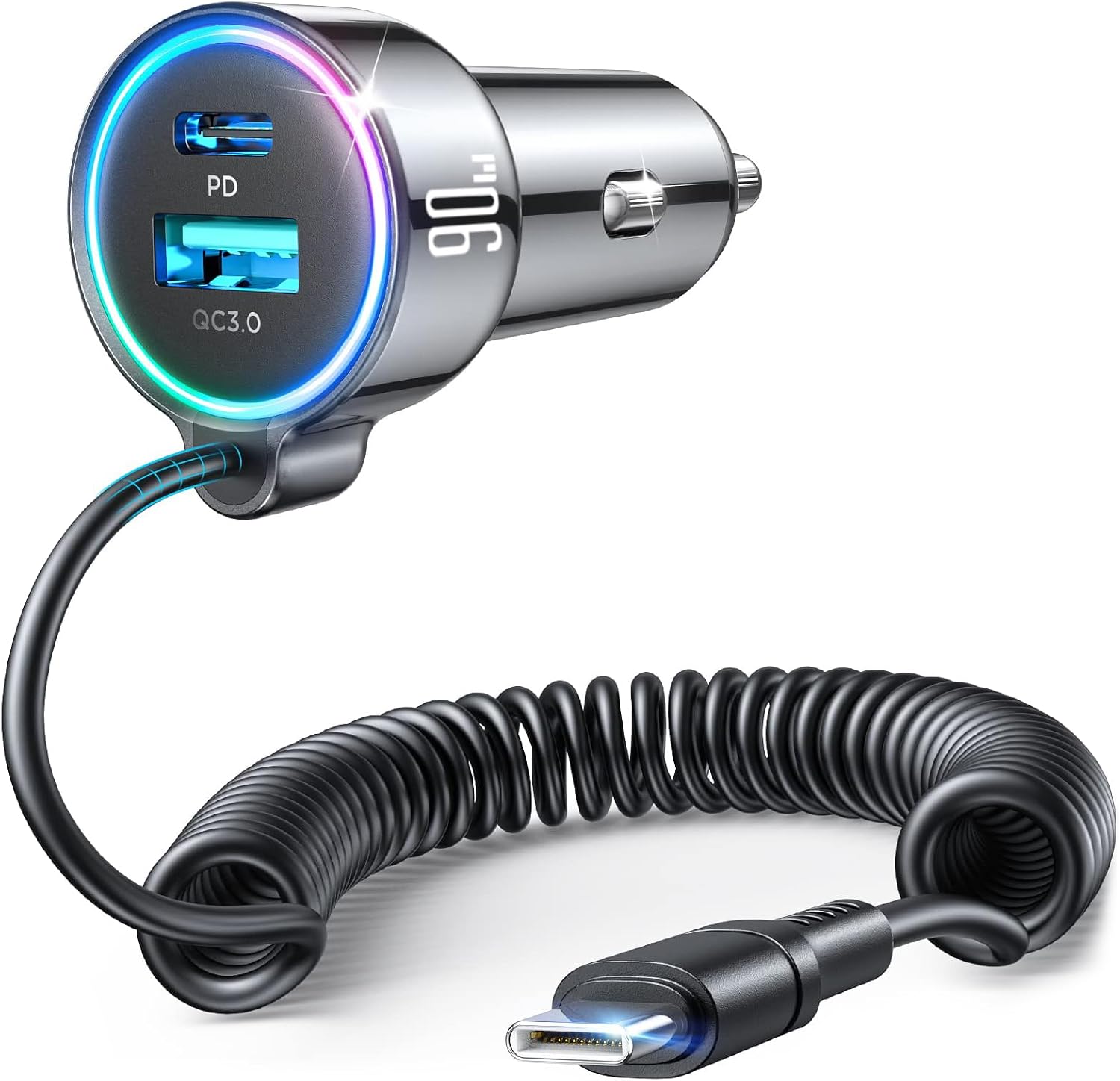
This 90W LISEN car charger delivers lightning-fast charging, powering three devices simultaneously with a convenient 60-inch retractable cable. Ideal for families and road warriors who need reliable, multi-device charging without the clutter.
Pros & Cons
Pros
Exceptional charging speed cuts typical car charging time in half
Three independent ports eliminate device competition and end family charging conflicts
Retractable design keeps dashboard organized while providing extended reach for back-seat passengers
Comprehensive safety certifications and multi-layer protection ensure reliable long-term use
Sleek design with ambient lighting enhances interior aesthetics while improving usability
Cons
iPhone 14 and earlier models require original Lightning cables to activate fast charging, limiting convenience for older devices
Premium pricing compared to single-port car chargers may deter budget-conscious buyers
Some users may find the 60-inch cable length excessive for smaller vehicle interiors
Detailed Review
The LISEN 90W car charger is a premium multi-device charging solution designed for families, ride-share drivers, and anyone who needs simultaneous fast charging on the road. With three independent ports and a powerful 90W output, it addresses the common frustration of multiple passengers competing for limited charging access during long drives.
Performance is where this charger truly excels. The 90W output achieves 0-80% battery charging in approximately 30 minutes, significantly outpacing standard car chargers. The 60-inch retractable coiled cable is a game-changer for organization, extending far enough to reach back-seat passengers or front-seat tablets while automatically retracting to keep your console pristine. The built-in 45W USB-C cable handles heavy lifting while two additional USB ports provide flexible charging options for various devices.
Build quality and safety are evident throughout the design. LISEN's UL, CE, FCC, and RoHS certifications backed by 200+ rigorous quality tests demonstrate serious engineering standards. The intelligent protection system guards against overheating, overcurrent, overvoltage, and short circuits. The subtle ambient halo glow is a thoughtful touch that helps you locate ports in darkness without creating dashboard glare, while the flush, sleek design complements modern vehicle interiors.
One limitation exists for older iPhone users. iPhone 14 and earlier models require your original Lightning cable to activate fast charging through the PD/QC ports, which reduces convenience for those with older devices. Additionally, the premium price point positions this above budget alternatives, though the multi-device capability and performance justify the investment for heavy users.
The LISEN 90W car charger is an excellent choice for families, frequent travelers, and professionals who need reliable, fast charging for multiple devices. Its combination of raw power, thoughtful design, and comprehensive safety makes it one of the best multi-port car chargers available for modern smartphone users.
Specifications
Power Output: 90W total (75W USB-C + USB-A combined) Connector Type: USB Type-C with integrated 45W coiled cable USB Ports: 2 total ports (1 USB-C with coiled cable, 1 USB-A) Cable Length: 60 inches retractable coiled design Input Voltage: 12V DC Amperage: 3A Compatible Devices: iPhone 16/17/18 series, Samsung Galaxy S8-S25, Google Pixel 1-10, and most USB-C Android devices Safety Certifications: UL, CE, FCC, RoHS certified with overload, overvoltage, overcurrent, and thermal protection Color: Black with ambient halo glow ring Brand: LISEN with 40+ million global users
Buyer Guide
Best For: This charger is ideal for families with multiple devices, ride-share drivers, long-distance commuters, and anyone frustrated with limited car charging ports. If you frequently have passengers or need to charge tablets alongside phones, this is your solution.
Consider This If: You own multiple newer devices (iPhone 16+, recent Samsung Galaxy phones) and need simultaneous fast charging. The 90W output and three-device capability make it perfect for power users. However, if you only charge one device occasionally, a simpler single-port charger may be more cost-effective.
Not Ideal For: Users with exclusively older iPhones (14 and earlier) who want plug-and-play fast charging without cables. Also consider your vehicle size, as the 60-inch cable may be overkill in compact cars, though it retracts neatly when not in use.
Installation Tip: This charger plugs into your vehicle's 12V cigarette lighter socket. Ensure your vehicle's socket supports continuous power or switched power based on your usage needs. Test the cable reach before purchasing if you have specific backseat charging requirements.
AI score rating is a scoring system developed by our experts. The score is from 0 to 10 based on the data collected by the AI tool. This score doesn't impact from any manufacturer or sales agent websites. Learn more ›
The FLYLEAD 90W car charger delivers simultaneous fast charging for up to three devices with a convenient built-in 45W USB-C coiled cable. Ideal for families and road warriors who need reliable, multi-device charging in vehicles without carrying extra cables.
Pros & Cons
Pros
Built-in 5-foot coiled cable eliminates need to carry separate charging cables in your vehicle
Simultaneous 3-device charging meets family and group travel needs efficiently
Supports latest iPhone and Samsung models with optimized PD and QC protocols
Rainbow-colored indicator light provides visibility without being distracting
Durable PC V-0 grade material is flame-retardant and oil-resistant
Cons
iPhone 14 and earlier models require using original Lightning cable rather than the built-in USB-C cable
5-foot cable length may feel short for some vehicle layouts or seating positions
Limited to 12-24V vehicles, not compatible with other power sources
Detailed Review
The FLYLEAD 90W car charger is a multi-port charging solution designed for drivers and passengers who need to power multiple devices during commutes and road trips. This product targets families, business travelers, and anyone tired of managing tangled cables and competing for limited charging ports in their vehicle.
The standout feature is the integrated 45W USB-C coiled cable combined with two additional USB ports, enabling simultaneous charging for three devices. Real-world performance includes PD45W speeds for newest iPhones, PD30W for iPhone 15, and PPS compatibility with Samsung Galaxy S26/S25/S24 series. The cable retracts neatly to reduce dashboard clutter and driving distractions, while the intelligent power management chip ensures stable charging regardless of device combination.
Build quality is solid with flame-retardant V-0 grade plastic construction and comprehensive safety certifications. The compact design fits fully into standard cigarette lighter ports without protruding excessively. The exclusive rainbow-colored indicator light provides adequate visibility for locating charging ports at night without creating eye strain or distraction.
The main limitation is that iPhone 14 and earlier models require using their original Lightning cables with the USB-C ports, reducing convenience for users with older iPhones. Additionally, the 5-foot cable may feel restrictive in larger vehicles or for passengers in rear seats.
Overall, this charger delivers excellent value for multi-device households and frequent travelers. The combination of fast charging speeds, built-in cable, and three simultaneous ports makes it a practical upgrade from single-port car chargers.
Specifications
Power Output: 90W total capacity with 45W USB-C PD, 30W USB-C PD, and 18W USB-A QC3.0
Ports: 3 USB ports (1x USB-C with built-in cable, 1x USB-C, 1x USB-A)
Built-in Cable: 5-foot retractable coiled USB-C cable with 45W fast charging
Compatibility: 12-24V vehicles including cars, SUVs, and trucks
Device Support: iPhone 18/17/16/15 Pro series, Samsung S26/S25/S24 series, Google Pixel, iPad, MacBook, and 100+ Android devices
Safety Features: Overcurrent, overvoltage, overload, overheating, and short-circuit protection
Certifications: UL, CE, FCC, RoHS
Material: Flame-retardant PC V-0 grade plastic
Warranty: 2 years
Buyer Guide
Who Should Buy This? The FLYLEAD 90W charger is ideal for families with multiple devices, frequent road trippers, delivery drivers, and anyone who wants to eliminate dashboard cable clutter. It's particularly valuable for households with mixed iPhone and Android devices.
When to Consider Alternatives: If you only charge one device or need faster than 45W charging for laptops, consider single-device high-wattage chargers instead. Users with exclusively older iPhones may prefer chargers with built-in Lightning cables.
Installation Tips: Plug directly into your cigarette lighter or 12V power outlet. The coiled cable retracts for storage but extend fully for comfortable reach to different seating positions. Keep the indicator light visible by not blocking it with cargo or dashboard items.
Maintenance: Occasionally wipe the connector with a dry cloth to prevent dust buildup. The retractable cable should be gently extended and retracted periodically to maintain smooth operation.
AI score rating is a scoring system developed by our experts. The score is from 0 to 10 based on the data collected by the AI tool. This score doesn't impact from any manufacturer or sales agent websites. Learn more ›
This 48W dual-port car charger combines a built-in 30W USB-C cable with an 18W QC 3.0 USB-A port, enabling simultaneous fast charging of two devices. It's ideal for Android users with Samsung Galaxy or Google Pixel phones who need rapid charging during commutes.
Pros & Cons
Pros
Exceptional charging speed, delivering 4X faster performance than standard car chargers
Built-in cable saves space and eliminates forgotten cables
Charges two phones at full speed simultaneously, perfect for families or shared vehicles
Intelligent device recognition ensures optimal charging for any compatible Android phone
Affordable price point with excellent value for dual-port fast charging capability
Cons
Built-in 3-foot cable may be too short for some vehicle layouts or rear-seat charging
Requires full insertion of USB-C connector to avoid heat generation from poor contact
Only compatible with Android devices, not suitable for iPhone users
Detailed Review
This 48W dual-port car charger is designed for Android users who demand fast charging on the road. It combines a built-in 30W USB-C Power Delivery port with an 18W QC 3.0 USB-A port, making it perfect for families, rideshare drivers, or anyone who frequently charges multiple devices in their vehicle. The charger works with all 12V and 24V vehicles and supports an extensive range of Samsung Galaxy, Google Pixel, and other Android devices.
The standout feature is the integrated 3-foot USB-C cable, which eliminates cable management hassles and ensures you always have a charger ready. Real-world testing shows it charges Samsung Galaxy S24 and S23 Ultra models from 0% to 80% in approximately 30 minutes, delivering performance four times faster than conventional car chargers. The dual-port design maintains full charging speed on both ports simultaneously, so you can charge your phone and a passenger's tablet without compromise.
Build quality is solid with a compact plastic design that fits snugly into standard cigarette lighter sockets without protruding awkwardly. The blue LED indicator provides visibility in low-light conditions without being distracting. Safety features include intelligent IC technology that detects your device and applies the optimal charging protocol, plus multiple protections against overcharging, overcurrent, and overheating.
The main limitation is the built-in 3-foot cable, which may feel restrictive if you need to charge a device mounted on your dashboard or in the back seat. Additionally, the charger requires full insertion of the USB-C connector to avoid heat generation from poor contact. This charger is not compatible with iPhones or other non-Android devices.
Overall, this is an excellent choice for Android users seeking reliable, fast dual-device charging at an affordable price. The combination of built-in cable convenience, rapid charging speeds, and safety features makes it a smart investment for daily commuters and frequent travelers.
Specifications
Power Output: 48W maximum (30W USB-C PD + 18W USB-A QC 3.0)
Input Voltage: DC 12V/24V
Connector Types: USB Type-C (built-in 3-foot cable), USB Type-A
Total USB Ports: 3 (1 USB-C with built-in cable, 1 USB-A, 1 auxiliary)
Compatible Devices: Samsung Galaxy S26/S25/S24/S23/S22/S21/S20 series, Galaxy Z Fold/Z Flip series, Galaxy A-series, Google Pixel 11/10/9/8/7/6/5/4 series, LG, Moto, and other Android phones and tablets
Design: Plug-in, compact plastic form factor, blue LED charging indicator
Weight: 5 grams
Warranty: 12 months with 24/7 customer service
Buyer Guide
Who Should Buy This Charger? Android users with Samsung Galaxy or Google Pixel phones who spend significant time driving and need fast charging. It's ideal for families sharing vehicles, rideshare drivers, sales professionals, and anyone who regularly charges multiple devices simultaneously.
Key Considerations: Verify your vehicle has a standard 12V or 24V cigarette lighter socket. The 3-foot built-in cable works best for center console or dashboard mounting. Ensure you fully insert the USB-C connector into your phone to avoid heat generation from poor contact. This charger does not support iPhones or USB-C equipped devices like newer iPad models with non-standard charging requirements.
Installation Tip: Insert the charger into your vehicle's cigarette lighter socket while the vehicle is in accessory mode (keys in ignition but engine off). The blue LED will illuminate when power is active. Test the charger with your phone before relying on it for critical charging situations.
Maintenance: Keep the cigarette lighter socket clean and free of debris. If charging speed decreases over time, ensure the USB-C port on your phone is clean and the connector is fully inserted. The charger will automatically stop when devices reach full charge, protecting battery health.
FAQ
Can I use a USB-A cable with a USB-C port?
No, the connectors are physically different. You need a USB-C to USB-C cable to use a USB-C port. Some chargers have a USB-A port as well, which accepts standard USB-A cables. If your device has a USB-C input but you only have a USB-A cable, you can use a USB-A to USB-C cable (with the proper connector on each end).
Why is my phone charging slowly even in a USB-C PD port?
Several factors can cause slow charging: the cable may not support fast charging, the charger may be sharing power with another device, or your phone’s battery management may be limiting speed (for example, if the battery is nearly full). Try using an e-marked cable that matches the charger’s wattage, and make sure no other device is connected that could reduce the port’s output. Also check that your phone supports PD fast charging.
Can a USB-C car charger damage my laptop?
If the charger is compliant with the USB Power Delivery standard and your laptop accepts USB-C charging, it is safe. The laptop negotiates the voltage and current with the charger, so it will only draw what it needs. However, using a cheap, non‑compliant charger could potentially cause issues. Stick to reputable brands and avoid chargers that claim wattages far beyond what your laptop requires. Always verify the charger’s specs match your laptop’s charging requirements.
Should I leave the charger plugged in all the time?
It depends on your vehicle. If your socket stays powered when the ignition is off, leaving the charger plugged in could slowly drain the car battery over many days or weeks. Most chargers draw a tiny amount of standby current, but it adds up. If you park your car for more than a week, it is safer to unplug the charger. For daily driving, leaving it plugged in is usually fine.
Choosing the right USB-C car charger comes down to matching the charger’s capabilities to your devices and your vehicle. Pay attention to per-port wattage, use an appropriate cable, and never exceed your socket’s fuse rating. With a proper setup, you can keep your phone, tablet, and even laptop powered on the road without hassle.
Learn how lithium jump starters work, why peak amps are misleading, and how to choose one for your gas or diesel engine. Includes safety, storage, and vs. jumper cables.
A guide to selecting a portable tire inflator: understand PSI ratings, fill speed, duty cycle, gauge accuracy, and what to consider for storage and extra uses.
This guide compares eight car Bluetooth adapters by listing specs, covering FM transmitters, AUX receivers, charging ports and microphone features. Check each listing for current details.
No single best backup camera fits every older car. These five picks were chosen by comparing listing specs, not hands-on testing. Check each listing for current details.
Guide to troubleshooting a backup camera that is not working: blank screen, flickering, blurry image, or wireless dropouts. Steps for factory and aftermarket systems.