By Lauren Holland
Updated November 2026
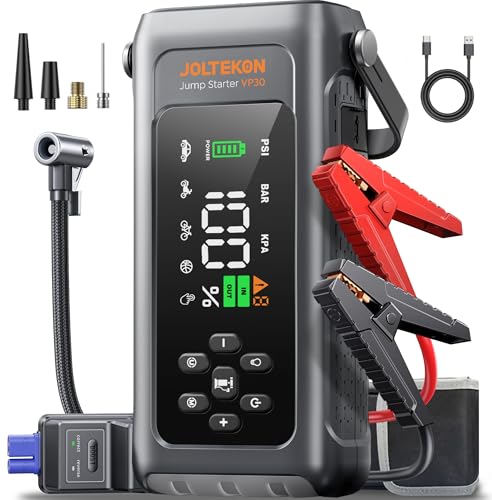
A car battery charger and tire pump combo can handle two common roadside jobs: topping off a weak battery and bringing a low tire back to its door-placard pressure. This guide explains how these combination units work, how to use the pump function correctly, and where the limits are, so you know what to expect before you need it.
How a Combo Unit Handles Both Jobs
Most combo units are a 12-volt charger or jump-start unit with a small built-in air compressor. The charger side draws power from a wall outlet or the battery itself, depending on the model. The compressor side runs on 12-volt power from the cigarette lighter or accessory socket, or from its own internal battery. Car Battery Charger with Tire Inflator: Setup, Uses and Limits (2026) covers the setup differences in more detail.
Shopping for one? See our guide: Car Battery Charger vs Jump Start (2026): Which Is Better for Your Dead Battery?.
Because the two functions share a housing, they rarely run at the same time. Use one, finish, then switch to the other.
Step-by-Step: Using the Pump Function
- Check the recommended tire pressure on the placard inside the driver’s door jamb, not the maximum pressure printed on the tire sidewall.
- Unscrew the valve cap and attach the pump’s hose or chuck firmly to the valve stem.
- Set the target pressure on the pump’s gauge or digital display if it has one.
- Plug the unit into the 12-volt socket with the engine running, so you do not drain the battery.
- Run the pump in short bursts and check pressure with a separate gauge. Built-in gauges can be off by a few PSI.
- Replace the valve cap and disconnect the hose cleanly.
Step-by-Step: Using the Charger Function
Connect the clamps to the battery terminals with the red clamp on positive and the black on negative or a chassis ground. Confirm the charger’s voltage and amp setting matches your battery type. Manufacturers generally advise a lower amp setting for maintenance charging and a higher setting only for a deeply discharged battery. Disconnect the clamps in reverse order when finished. Using a Battery Charger for Car: Step-by-Step Safe Charging Guide walks through the full sequence.
Limits to Know Before You Buy or Use One
A combo unit is a convenience, not a replacement for dedicated equipment. The table below compares typical limits.
| Factor | Combo Unit | Dedicated Unit |
|---|---|---|
| Air pump speed | Slow, suited to small top-offs | Faster, suited to large or flat tires |
| Charging current | Usually modest | Often higher, with more settings |
| Portability | One item to pack | Two items to store |
If you regularly fill large truck or trailer tires, a standalone compressor will save time. For a battery that is badly sulfated or has a shorted cell, no charger will restore it, and Testing a Car Battery Charger: A Practical Guide (2026) explains how to confirm whether the charger itself is working.
Common Mistakes
- Running the pump with the engine off, which drains the battery you are trying to protect.
- Inflating to the tire sidewall maximum instead of the vehicle’s recommended pressure.
- Reversing the battery clamps, which can damage the charger and the car’s electrical system.
- Letting the pump run continuously, which can overheat its motor.
- Skipping a separate gauge check after the unit reports it has reached the target.
Recommended Gear
- A portable 12-volt tire inflator with a digital gauge helps you hit the placard pressure accurately without guessing. View on Amazon
- A smart battery maintainer adjusts its output automatically, which suits vehicles parked for long stretches. View on Amazon
- A handheld tire pressure gauge gives you an independent reading to check the pump’s display. View on Amazon
FAQ
Can I use a car battery charger and tire pump at the same time?
No. Most combo units are designed for one function at a time, so finish one job before starting the other.
Does running the tire pump drain the car battery?
It can, especially with the engine off. Run the pump while the engine is running to keep the battery from losing charge.
How do I know what tire pressure to set?
Use the recommended pressure on the placard inside the driver’s door jamb. The number on the tire sidewall is the maximum safe pressure, not the target.
Conclusion
A car battery charger and tire pump combo covers two frequent roadside needs in one unit. Use the engine-running method, set pressure from the door placard, and verify readings with a separate gauge. For heavy tire work or frequent charging, a dedicated tool will serve you better.
Related reading
Ready to choose one?
About Lauren Holland
Lauren Holland is part of our editorial team and reviews and edits our car care & garage supplies guides, checking product details against manufacturer specifications and owner feedback.