As an Amazon Associate I earn from qualifying purchases. This page may contain affiliate links.
A portable electric car battery charger lets you top up or revive a dead 12V battery without a second vehicle or a trip to a shop. For drivers who park in a garage without outlets, keep a car at a campsite, or want a backup for a battery that drains slowly, a compact unit that plugs into a wall outlet and clips onto the battery terminals is one of the most practical tools to keep in the trunk or on a shelf. The picks below were chosen by comparing manufacturer specifications, brand reputation and the patterns owners commonly describe in their feedback. We weighed output amperage, charging modes (standard, maintenance and repair), safety protections such as reverse-polarity and short-circuit detection, cable length, portability and suitability for common battery types including flooded, AGM and lithium options. Use this as a starting point, then match the list to your battery size and how often you plan to use it.
Our Top Picks
Quick Comparison
| Product | Best for | Key feature |
|---|---|---|
| NOCO Genius GENIUS5 | Everyday maintenance of a parked car | Smart 5-amp charger with reconditioning mode |
| NOCO Genius GENIUS10 | Larger batteries and trucks | 10-amp output for faster recharging |
| CTEK MXS 5.0 | Owners who want a long-term maintainer | Eight-step charging with temperature compensation |
| Schumacher SC1281 | Budget-minded drivers needing a repair mode | Engine start assist and 15-amp boost option |
| Battery Tender Plus 021-0128 | Seasonal vehicles in storage | Automatic float maintenance |
| Antigravity Micro-Start XL-75 | Compact emergency use with charging | Lightweight pack that doubles as a jump starter |
| DEWALT DXAE35E | Owners who already use DEWALT tools | Portable 12V and 20V-compatible power source |
| Foval FV-85000 | Mixed use with jump starting | Combined jump starter and power bank |
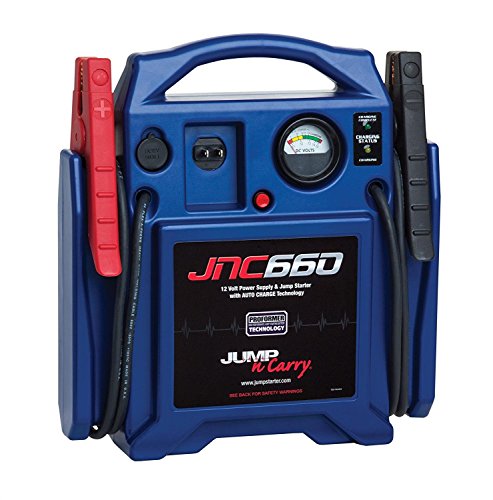
| Clore Automotive Jump-N-Carry JNC770 | Quick recovery in cold weather | High cranking current for stubborn starts |
| Ampeak 12V Portable Battery Charger | Lightweight travel use | Compact design with multiple protection circuits |
NOCO Genius GENIUS5
This is a good fit for drivers who want a small, automatic charger to keep a car battery topped up during long periods of non-use. Owners often describe it as a set-and-forget unit for seasonal cars and motorcycles.
Key specs
- Output: 5 amps
- Battery types: flooded, AGM, gel and lithium (LiFePO4)
- Battery range: roughly 6V and 12V systems
- Modes: charge, maintain and reconditioning
Pros
- Automatically adjusts charge rate and stops when full
- Reconditioning mode can help recover sulfated batteries
- Compact enough to store in a garage cabinet
Cons
- A 5-amp output is slow for a fully drained battery
- Cable length is short for some vehicle placements
NOCO Genius GENIUS10
Suited to larger batteries, including those in trucks, SUVs and some marine applications, where a higher output shortens the recharge time.
Key specs
- Output: 10 amps
- Battery types: flooded, AGM, gel and lithium
- Battery range: 6V and 12V systems
- Modes: charge, maintain and reconditioning
Pros
- Faster recharge than 5-amp models on large batteries
- Multi-stage charging protects battery health
- Reverse-polarity protection guards against clamp mistakes
Cons
- Heavier than smaller units, so less convenient to carry
- Overkill for a small battery used only for light maintenance
CTEK MXS 5.0
Aimed at owners who want a long-term maintainer that adjusts to conditions, especially in climates with large temperature swings.
Key specs
- Output: 5 amps
- Charging process: eight steps
- Battery types: flooded, AGM, gel and lithium
- Temperature compensation included
Pros
- Eight-step process is thorough and well regarded by owners
- Temperature compensation suits cold garages
- Rugged housing with weather-resistant design
Cons
- Limited to 5 amps, so not ideal for rapid recharging
- Learning the mode and battery settings takes a little time
Schumacher SC1281
A practical choice for drivers who want a charger that also offers engine start assistance and a boost function for dead batteries.
Key specs
- Charging output: up to 15 amps in boost mode
- Engine start assist function
- Battery types: flooded, AGM and gel
- 12V system
Pros
- Versatile, combining charger, maintainer and starter assist
- Useful for recovering a deeply discharged battery
- Widely available from a long-established brand
Cons
- Boost mode should be used carefully to avoid overheating a battery
- Not all owners find it as quiet or compact as smaller units
Battery Tender Plus 021-0128
Designed for vehicles sitting for weeks or months, such as classic cars, motorcycles and boats, where steady float maintenance matters most.
Key specs
- Output: 1.25 amps
- Battery types: flooded, AGM, gel and lithium
- Automatic float maintenance
- 12V system
Pros
- Low output reduces the risk of overcharging stored batteries
- Simple operation with few settings
- Well suited to long-term storage
Cons
- Too slow to revive a battery that is badly discharged
- Not designed for rapid recharging
Antigravity Micro-Start XL-75
A lightweight option for drivers who want a compact emergency unit that can also help recover a low battery when a wall outlet is not available.
Key specs
- Compact lithium pack design
- Designed for 12V vehicle systems
- Includes USB output for phone charging
- Rechargeable from a wall outlet
Pros
- Very portable and easy to stow in a trunk
- Doubles as a jump starter and power bank
- Useful during roadside emergencies
Cons
- Not a full replacement for a dedicated battery charger on a deeply drained battery
- Pack capacity limits how many starts or charges it can deliver before recharging
DEWALT DXAE35E
Best for owners who already own DEWALT tools and want a portable power source that works on a vehicle battery as well as for job-site use.
Key specs
- Portable power station with 12V output
- Built-in jump start function
- USB outputs for device charging
- Rechargeable from a wall outlet
Pros
- Strong brand reputation in power tools
- Useful beyond car charging, including for job sites
- Rugged construction suited to rough handling
Cons
- Bulkier and heavier than dedicated car chargers
- Designed more as a power station than a precision battery maintainer
Foval FV-85000
A versatile choice for drivers who want jump starting, USB charging and a backup power source combined in one portable unit.
Key specs
- Combined jump starter and power bank
- Multiple USB output ports
- Designed for 12V vehicle batteries
- Built-in flashlight
Pros
- Multi-function design reduces the number of items to carry
- Useful for phone and device charging in emergencies
- Compact for its feature set
Cons
- Capacity claims can vary, so check real-world starts per charge
- Not a dedicated smart charger for long-term maintenance
Clore Automotive Jump-N-Carry JNC770
Owners in cold climates often reach for this type of unit because a high cranking current can help start an engine when the battery is weak and the temperature is low.
Key specs
- High peak cranking amps
- 12V vehicle system
- Built-in air compressor on some configurations
- Portable design with carry handle
Pros
- Strong cranking output for cold starts
- Established brand in automotive tools
- Simple, direct operation
Cons
- Primarily a jump starter, so charging capability is limited
- Heavier than lightweight pocket-size packs
Ampeak 12V Portable Battery Charger
A lightweight travel-oriented option for drivers who want a simple unit to carry in a bag or glovebox for occasional use.
Key specs
- Compact portable design
- 12V vehicle battery support
- Multiple built-in protection circuits
- Clamp-style connection to terminals
Pros
- Easy to carry and store
- Protection circuits help prevent connection errors
- Good for occasional top-ups
Cons
- Lower output means longer charge times
- Less suitable for large batteries or frequent heavy use
Buying Guide
Choosing the right portable electric car battery charger comes down to how you plan to use it. A charger for a car that sits all winter is very different from one kept in the trunk for emergencies. Before you compare models, review the basics below. For broader background on this category, see Car Battery Maintainers, Trickle Chargers and Smart Chargers and Best Car Battery Maintainers and Trickle Chargers.
Selection criteria
- Use case: maintenance, recharging, emergency starting, or a combination.
- Battery size: match the charger’s output to the capacity of your battery.
- Battery chemistry: confirm support for flooded, AGM, gel or lithium if your vehicle uses them.
- Portability: weight and dimensions matter if you carry the unit regularly.
Important features
- Multi-stage or smart charging, which adjusts current as the battery fills.
- Reverse-polarity protection, which guards against clamping the wrong terminals.
- Short-circuit and overcharge protection.
- Temperature compensation for cold or hot environments.
- Maintenance or float mode for long storage periods.
Specs to check
Output amperage is the most important number. As a general guide, a 1 to 2 amp unit suits maintenance, 4 to 6 amps suits routine recharging, and 10 amps or more suits larger batteries or faster turnaround. Check the rated voltage, which should be 12V for most passenger cars, and confirm the cable length reaches your battery without strain. Manufacturers specify input voltage requirements, so verify your outlet matches before purchase.
Choosing by need
- Seasonal or stored vehicles: choose a low-amp float maintainer.
- Daily drivers with occasional drain: a 5-amp smart charger offers a good balance.
- Trucks and large batteries: consider a 10-amp model.
- Emergency kit use: a compact jump starter with charging capability may suit better.
Things to watch out for
- Do not assume a jump starter can replace a charger for long-term battery health.
- Avoid charging a visibly damaged, leaking or frozen battery.
- Always connect clamps in the correct order and keep them away from moving engine parts.
- Work in a ventilated area, since batteries can release hydrogen gas during charging.
If you are unsure about a battery problem or electrical work, consult a qualified automotive technician.
FAQ
Can a portable electric car battery charger fully recharge a dead battery?
Yes, if the battery is not physically damaged and the charger has enough output for the battery size. Lower-amp units take longer, so a fully drained battery may need many hours. Check the battery’s condition first, since a battery that will not hold a charge may need replacement.
Is it safe to leave a portable battery charger connected overnight?
Smart chargers with automatic shutoff or float mode are generally designed for extended connection. Basic chargers without these features should not be left unattended. Follow the manufacturer’s instructions for your model.
What is the difference between a charger and a jump starter?
A charger replenishes a battery slowly and safely over time. A jump starter delivers a short, high-current burst to start an engine. Some products combine both functions, but a dedicated charger is usually better for long-term battery care.
Can I use a car battery charger on a lithium car battery?
Only if the charger is specified for lithium chemistry. Many modern vehicles use standard lead-based batteries, but some use lithium. Confirm compatibility in the charger’s documentation before connecting it. For more on chargers in this category, see 9 Best Car Battery Trickle Charger Options for Every Need (2026).
Why does my charger show an error or refuse to start?
Common causes include reversed clamps, a battery voltage that is too low for the charger to detect, corroded terminals or a faulty outlet. Clean the terminals, confirm the connection, and check the outlet. If the problem continues, a deeply discharged or damaged battery may be the cause.
How long does a portable charger take to charge a car battery?
It depends on battery size, state of charge and charger output. As a rough guide, a 5-amp charger may take many hours to recover a fully depleted battery, while a 10-amp unit can cut that time significantly. Manufacturers typically publish estimated charge times for their models.
Do I need a charger with a reconditioning mode?
It can help if your battery has lost capacity due to sulfation, which is common in batteries that sit discharged for long periods. Reconditioning is not guaranteed to restore a worn battery, so treat it as a possible recovery step rather than a fix for an old battery.
Where should I read more about car charging basics?
For a broader look at USB and 12V accessories, see USB-C Car Chargers: Wattage, Power Delivery and Two-Port Charging. If your car’s 12V socket is not supplying power, Car Charger Not Working? How to Fix a 12V Socket or USB Port covers common causes.
Conclusion
A portable electric car battery charger is a practical tool for keeping a vehicle ready. For long-term storage, a low-amp float maintainer such as the Battery Tender Plus or the CTEK MXS 5.0 suits the job. For daily drivers that need occasional recharging, a 5-amp smart charger like the NOCO Genius GENIUS5 offers a balanced choice, and the GENIUS10 suits larger batteries. Drivers who want emergency starting alongside charging may prefer a combined unit such as the Foval FV-85000 or the Antigravity Micro-Start XL-75, while owners in cold climates may value the cranking output of the Clore JNC770. Match the output, battery chemistry and portability to your actual use, and when a battery problem persists, have a qualified technician inspect it.