By Lauren Holland
Updated November 2026
A club car lithium battery charger has to match the battery chemistry and voltage of your golf cart. Lithium packs need a charger with a lithium charge profile, not the lead-acid profile that came with most older carts. Using the wrong one can leave the pack undercharged, trip the battery management system, or damage cells over time.
Why a Lead-Acid Charger Doesn’t Work on Lithium
Lead-acid chargers use a multi-stage curve that ends in a float or absorption phase. Lithium iron phosphate (LiFePO4) packs, which Club Car and many aftermarket kits use, expect a constant-current then constant-voltage cycle that stops at a tightly set cell voltage. A lead-acid charger may never reach the stop point the battery management system (BMS) expects, so the pack sits partly charged, or the BMS cuts charging entirely once a cell hits its high-voltage limit.
Shopping for one? See our guide: 6 Best Battery Chargers for Club Car Precedent Models (2026).
Some lithium packs also include a built-in communication link between the BMS and the charger. If the charger doesn’t speak that protocol, the cart may show a fault or refuse to start charging. Check your battery documentation before assuming the charger is the problem.
What to Check Before You Blame the Charger
Several factors cause charging failures that look like charger faults:
- Voltage mismatch: A 36-volt charger on a 48-volt pack, or the reverse, will not complete a charge cycle.
- Charger type: Confirm the charger is rated for lithium, not just “smart” or “universal” in a general sense.
- BMS lockout: If one cell is over or under voltage, the BMS can block charging until the pack is balanced.
- Connector and cable condition: Corroded terminals or a worn plug add resistance and can trigger faults.
- Temperature: Most lithium packs refuse to charge below freezing. Let the pack warm up first.
Steps to Get Your Cart Charging Again
- Read the pack label and manual for voltage, chemistry, and charger compatibility.
- Confirm the charger’s output voltage matches the pack using a multimeter at the connector.
- Inspect the plug, receptacle, and battery terminals for corrosion, scorching, or loose fittings. Clean and tighten as needed.
- Note any indicator light patterns or error codes and look them up in the charger or battery manual.
- If the BMS shows a fault, use the manufacturer’s reset procedure rather than repeatedly plugging and unplugging.
- If problems continue, have a qualified technician or the battery supplier check the pack. Lithium packs can be hazardous if damaged, so don’t open or probe cells yourself.
What We’d Use
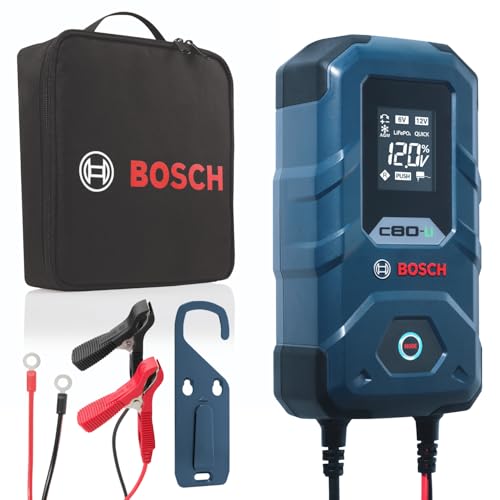
For a lithium-specific option that matches common Club Car lithium packs, look at a dedicated LiFePO4 golf cart charger from a battery manufacturer rather than a generic universal unit: View on Amazon.
If you need a replacement cord or adapter to match your existing plug, search for it directly: View on Amazon.
FAQ
Can I use my old Club Car charger on a lithium battery?
Usually not. Older lead-acid chargers use a charge profile that lithium packs don’t expect, so the pack may charge partially or fault. Confirm with the battery maker before connecting.
Why does my lithium cart stop charging before it’s full?
The BMS may have cut off because one cell reached its voltage limit or the pack is out of balance. Check for error codes and follow the manufacturer’s reset or balancing steps.
Is it safe to charge lithium golf cart batteries in cold weather?
Most lithium packs should not be charged below freezing. Bring the pack to room temperature first, and consult the battery manufacturer or a professional if you have concerns.
Related reading
- Club Car Battery Charger: A Step-by-Step Guide for Golf Cart Owners
- Battery Charger for a Club Car Golf Cart: How to Choose and Use One (2026)
- 7 Best Power Drive Battery Charger Club Car Options for Every Need (2026)
- 6 Best Club Car Battery Charger 36 Volt Models for Every Need (2026)
- 48 Volt Club Car Battery Charger: A Step-by-Step Guide for Beginners
- 4 Best Club Car Golf Cart Battery Charger 48 Volt Picks for Every Need (2026)
Ready to choose one?
About Lauren Holland
Lauren Holland is part of our editorial team and reviews and edits our car care & garage supplies guides, checking product details against manufacturer specifications and owner feedback.