When your vehicle stops running or you have a flat tire on a busy road, the biggest danger is not the mechanical problem. It is being hit by another driver who did not see you in time. The right sequence of actions and a few simple items from your trunk can make the difference between a stressful wait and a serious crash. This guide covers what to do first after a breakdown, how to use warning triangles and reflective gear correctly, and how to keep yourself visible until help arrives.
What to Do First After a Breakdown
Your immediate actions set the stage for everything that follows. Stay calm and follow the same routine every time, even on familiar roads or in daylight.
Move Off the Road If You Can
If the vehicle still rolls and the tires are intact, steer it as far away from traffic as possible. Aim for the right shoulder, a wide emergency lane, a parking lot entrance, or any flat paved area that leaves room between your car and moving traffic. If the engine died but the key turns, shift to neutral and use the remaining momentum to coast to the shoulder. Do not attempt to cross multiple lanes of heavy traffic to reach the left shoulder. It is safer to stop on the right side of the road, even if that means walking a little farther.
If you cannot move the vehicle at all, or if it stops in a travel lane, do not get out and walk forward to wave down traffic. Turn on your hazard lights and stay restrained inside the vehicle until you have assessed the situation and decided it is safe to exit. If traffic is dense and moving fast, remaining inside with your seat belt on is often safer than standing next to the car.
Turn On Hazard Lights
Activate the hazard warning lights immediately, whether you are moving to the shoulder or already stopped. This is the fastest way to tell other drivers that your vehicle is not moving normally. In many vehicles the button is marked with a red triangle and is located on the dashboard or center console. Keep the hazards on for the entire time you are stopped, including during a tire change or while waiting for a tow.
Decide Whether to Stay in the Car or Get Out
If you are on the shoulder and traffic is passing at highway speed, stay inside with your seat belt on unless you need to place warning triangles or perform a quick repair. Call for roadside assistance or a tow truck first, then set up your reflective gear while you wait. If the vehicle is in a dangerous position, such as just over a hill or around a curve, get out on the side away from traffic, move a safe distance behind the guardrail or beyond the barrier, and call for help from there.
Your judgment matters. On a quiet rural road with light traffic, exiting to inspect the problem may be reasonable. On an interstate, the safest place is usually inside the vehicle with the seat belt on, with warning triangles placed behind you to alert approaching drivers.
Warning Triangles: The Core of Roadside Visibility
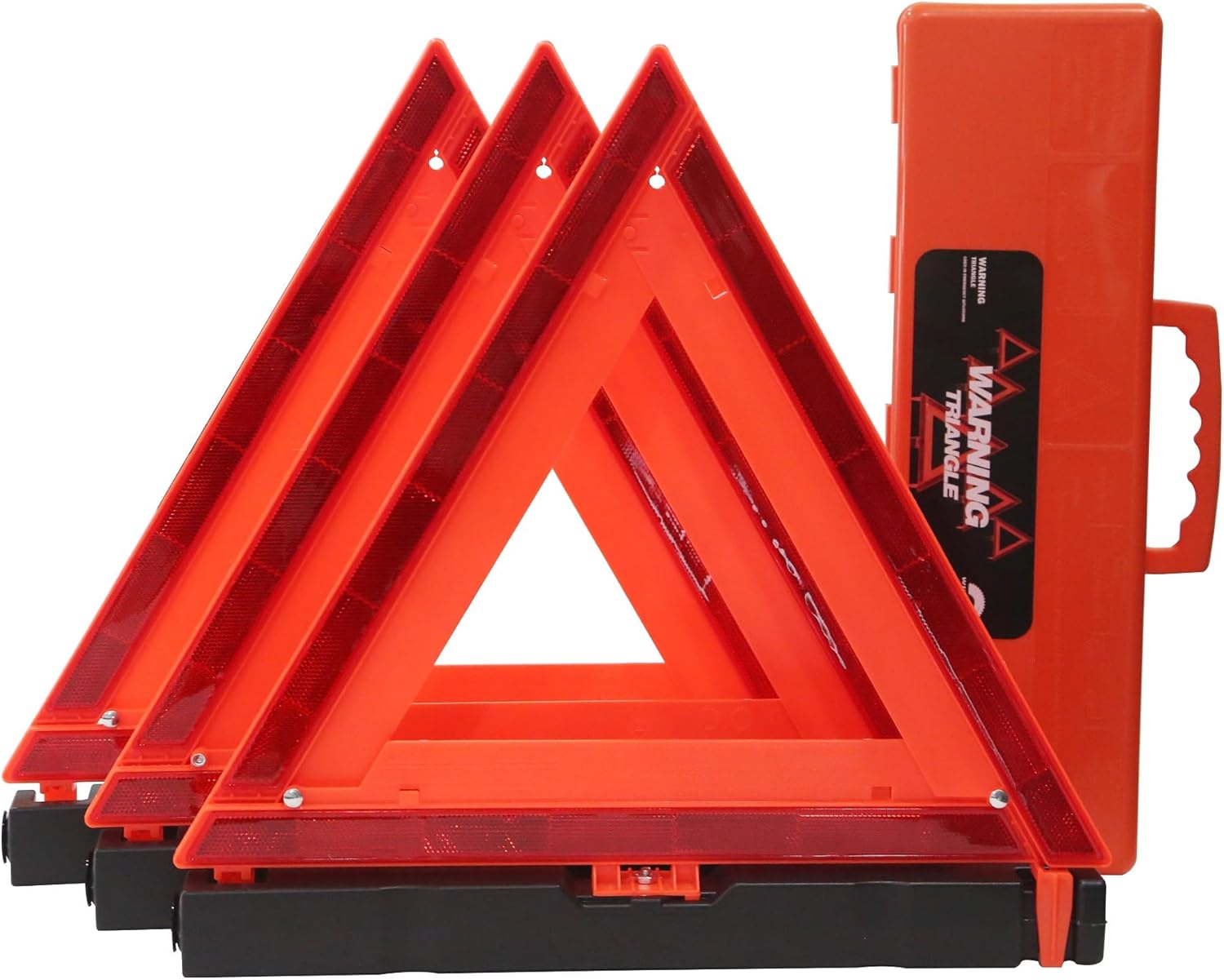
Warning triangles are reflective devices that fold flat and stand on the pavement to give approaching drivers early notice of a stopped vehicle. They are required equipment for commercial trucks, and they are a sensible addition to any passenger car emergency kit. Unlike flares, they do not burn, produce smoke, or pose a fire hazard, and they can be reused many times.
Warning Triangles Versus Flares Versus LED Flares
Traditional chemical flares burn with a bright flame and are highly visible, but they have serious drawbacks. They can ignite spilled fuel or dry grass, they eventually burn out, and they leave residue. LED flares use bright lights and flashing patterns, are reusable, and run on batteries, but they can be less visible in bright sunlight. Reflective warning triangles work without power and remain effective in daylight because their reflective surface returns light from approaching headlights.
Many roadside kits combine two types: a set of reflective triangles for passive visibility and an LED flare for active flashing. This combination gives you reliable warning power in daylight, at night, and in fog. If you carry flares, follow the manufacturer’s instructions and never place them near fluids that could ignite.
How Many Triangles Do You Need
A single triangle is better than none, but three is the number to aim for. Commercial and fleet drivers often carry three because they need to space them over a long distance. For a passenger car, two or three triangles give approaching traffic time to slow down safely. If your emergency kit only holds one, place it far enough back that drivers see it well before they reach your vehicle, and keep the vehicle’s hazard lights on.
Where and How to Place Warning Triangles
Triangle placement follows a simple principle: give approaching traffic the earliest possible warning without creating a new hazard. You want the triangle to be visible, not to sit in a lane where a driver swerving to avoid it could crash.
General Guidance for Passenger Cars
Place the first triangle a short distance behind the vehicle, and the second one farther back so that traffic sees it first. Start by putting one triangle about 10 large steps behind your car, at the edge of your lane or just off the pavement. Then walk back another 10 to 20 large steps and place the second triangle. If you have a third, place it even farther back, especially on roads with higher speed limits.
On a two-lane road, consider placing one triangle behind your car on your side of the road and one on the opposite side if the curve or hill hides your vehicle from drivers in the other direction. Do not place triangles in the middle of the road, and do not put them so close to the vehicle that drivers cannot react in time.
Rules and Distances for Commercial Vehicles
Commercial truck drivers in the United States follow the Federal Motor Carrier Safety Administration (FMCSA) rules for warning devices. These rules require a set of three devices, and the placement distances are specific. On a divided or one-way road, the devices go about 10 feet, 100 feet and 200 feet behind the vehicle. On a two-lane road with traffic in both directions, one device goes about 10 feet behind the vehicle, one about 100 feet behind, and one about 100 feet ahead to warn traffic coming from the other direction. Hills, curves and other obstructions have their own placement rules.
These FMCSA distances are designed for large trucks and for roads with higher speeds. For a passenger car, you do not need to follow those exact numbers, but the logic is the same: place the warning devices far enough back that a driver has time to see them and slow down. A reasonable guide for passenger cars on a divided highway is roughly 10 feet, 100 feet and 200 feet behind the car when conditions allow, but you must walk safely to set them and retrieve them. If walking that far is risky, place the triangles as far back as you can do so while staying safely off the travel lane.
On Hills and Curves
Hills and curves reduce the distance at which drivers can see your vehicle. If you stopped just beyond a hill crest, approaching drivers may not see your car until they are nearly on top of it. In that situation, place the first triangle at or slightly beyond the crest, before the point where oncoming drivers can see your vehicle. Walk back far enough that the triangle is visible before the crest, and place it on the shoulder or just off the pavement.
On a curve, place the triangle before the curve in the direction from which traffic approaches. Drivers need the warning before they enter the bend, not after they are already turning. If your vehicle is on a curve, walk backward along the shoulder until you reach the approach side, set the triangle, and then return to your vehicle or to a safe position.
Retrieving Triangles Safely
After the repair or tow truck arrives, you must collect the triangles. Wait for a gap in traffic, walk on the shoulder facing oncoming vehicles, and retrieve the farthest triangle first, then work your way back toward the car. Never turn your back to traffic while walking. If you cannot retrieve a triangle safely, ask the tow truck driver for help or leave it and return when traffic clears.
Reflective Vests and High-Visibility Gear
Warning triangles warn drivers about your vehicle, but they do not make you visible when you are moving around the car or walking along the road. A reflective vest turns your body into a visible object, especially at night and in low light. Many roadside emergency kits include a bright yellow or orange vest with reflective strips. Keep it in the trunk, not in the house.
When to Wear a Reflective Vest
Wear the vest any time you are outside the vehicle on or near a traveled road. That includes changing a tire, placing triangles, checking for damage, talking to the tow truck driver, or walking to a safe location. If you carry a vest for each person who typically rides with you, everyone who exits the car can be visible. Children and passengers should stay in the vehicle with seat belts on unless the vehicle is in a position where staying inside is clearly more dangerous.
Reflective vests work because the reflective material returns light from headlights back toward the driver. In daylight, the bright color of the vest provides contrast against the road surface. For night use, make sure the reflective strips are clean and not folded away. Store the vest flat or hung in the trunk so the reflective material does not crease and lose effectiveness.
Walking Safely Facing Traffic
When you must walk along a road after a breakdown, always walk facing oncoming traffic. This lets you see approaching vehicles and react if their path angles toward you. Walk on the shoulder, as far from travel lanes as the terrain allows. Do not walk with your back to traffic, because a vehicle can drift toward the shoulder and you will not have time to move.
If you are on a divided highway with traffic only behind you on your side, walking to a safe location ahead of your vehicle may be better. Use your judgment and follow the guidance of police or tow truck operators if they are on scene. If a law enforcement officer stops, follow the officer’s instructions, even if they differ from the general advice in this article.
Storing Emergency Gear in the Trunk
Roadside visibility gear only helps if it is in the vehicle when you need it. A small dedicated storage bag or container in the trunk keeps triangles, vests, and related items together and accessible.
What to Keep in Your Roadside Visibility Kit
- A set of at least three warning triangles
- One reflective vest per regular occupant, sized to fit
- An LED flare or flashlight with flashing mode as a supplement
- Spare batteries for the LED flare and flashlight
- Gloves to protect your hands when placing or retrieving triangles
In addition to visibility gear, your trunk should hold the basics for a breakdown: a working spare tire, jack, and lug wrench, plus a tire inflator or sealant kit if your vehicle does not carry a spare. A fully charged portable jump starter and a basic tool kit are useful, but the visibility items come first because they keep you alive while you wait for help.
Check your triangles and vests periodically. Replace damaged or cracked triangles, clean dirty reflective surfaces, and confirm that batteries in any LED devices still hold a charge. A triangle with a broken stand or a missing reflective panel cannot warn drivers reliably.
For a more complete list of what belongs in your emergency kit, see the roadside emergency kit checklist. If you drive in cold climates, add the items described in the winter car emergency kit guide so that visibility gear works in snow and ice conditions. You may also want to review the car first aid kit checklist for injuries that could happen during a roadside stop, and the broader emergency and roadside equipment section for other safety gear.
Common Mistakes to Avoid
Drivers often make well-intentioned errors that reduce the effectiveness of their warning gear. Learn these mistakes before you need to be on the shoulder.
Turning Off the Hazard Lights
After a few minutes, it can feel like the hazard lights are unnecessary, especially in daylight. Keep them on. Flashing lights are one of the strongest visual cues that a vehicle is stopped. Turning them off to save the battery is a bad trade if your battery is already in good condition. If you are concerned about battery drain, rely on triangles as well, but keep the hazards on. In most modern cars, a hazard light system draws little power and can run for hours, but follow the vehicle owner’s manual.
Placing Triangles Too Close
A triangle set only a few feet behind the car does not give drivers time to slow down. At highway speed, a vehicle travels the length of a football field in seconds. Place triangles as far back as you safely can, and remember that the farthest triangle is the first one a driver sees. If your triangles are clustered at the rear bumper, they are almost useless.
Standing Behind or Beside the Car
Do not crouch behind the rear bumper to check the damage, and do not stand between your vehicle and the travel lane. The space behind your car is where an inattentive driver will hit first. If you must inspect something, stand on the side away from traffic, behind the guardrail if present, and keep your eyes on approaching vehicles.
Trusting Flares Around Fuel or Grass
Chemical flares burn hot and can ignite fuel vapors, oil, or dry vegetation. Use them only if you are sure the pavement is clear of any flammable fluids and there is no grass nearby. LED flares and reflective triangles do not have this risk. If a flare is your only tool, place it at least several car lengths away from your vehicle and away from the fuel filler area.
Forgetting the Vest at Home
A reflective vest in the garage does not help you. Store all roadside visibility gear in the trunk or in a cargo compartment inside the vehicle, not in the house. Make it a habit to check the trunk before long trips and after any time the vehicle is serviced, because a mechanic may remove items and forget to replace them.
Troubleshooting Roadside Visibility Issues
Sometimes conditions make it hard to follow the normal placement routine. Use these troubleshooting tips to adapt.
What If You Cannot Walk Far Enough to Place Triangles?
Physical limitations, darkness, heavy traffic, or a narrow shoulder can make long walks unsafe. In that case, stay in the vehicle with your seat belt on, keep the hazard lights flashing, and call for help. Set one triangle just behind the vehicle if you can do so without leaving the shoulder, or skip triangles entirely if placing them would put you in danger. A tow truck driver or police officer can set up additional warning devices when they arrive.
What If It Is Foggy or Raining?
Low visibility makes reflective triangles less effective because drivers may not see them until they are very close. Add an LED flare with a flashing mode to catch attention earlier. Keep your headlights on even in daylight, and use the vehicle’s hazard lights. If the vehicle has fog lamps, turn them on as well, but do not rely on them to warn oncoming drivers.
What If You Stop in a Tunnel or Underpass?
Tunnels are particularly dangerous for stopped vehicles because there is no shoulder and drivers’ eyes are adjusting from daylight. Stay inside the vehicle with seat belts on and call for help immediately. Do not get out to place triangles unless you have clear confirmation that traffic is stopped or the tunnel is closed. The vehicle’s hazard lights and headlights are your primary warning tools there.
What If You Have No Warning Triangles at All?
If you do not carry triangles, use the vehicle’s own features. Open the trunk and lift the deck lid if it is safe, because that increases the visible profile of the vehicle. Raise the hood if you are certain the engine is cool and no burned fluids are present, although a raised hood also signals distress. Use a brightly colored cloth tied to the antenna or door handle as a passive signal. None of these match the effectiveness of proper triangles, so add a set to your trunk before your next trip.
Legal and Regulatory Notes
Rules on warning devices for passenger vehicles vary by state, while commercial vehicles face stricter federal requirements, and laws about hazard lights and emergency devices change. Check your state’s motor vehicle regulations or ask a local law enforcement agency about the rules where you drive. For commercial vehicles, the federal FMCSA rules apply on interstates, and state rules may add requirements. Always follow the specific rules that apply to your vehicle type and your location.
When you are stopped at the roadside, police officers may approach and ask for your license, registration, and proof of insurance. Keep those documents in the glove box or a center console holder so you do not need to rummage through a trunk full of gear while standing on the shoulder.
Building a Roadside Visibility Routine
A good routine takes the guesswork out of a stressful situation. Practice it once in a safe parking lot so that placing triangles and putting on a vest feels natural. Know where your emergency kit sits in the trunk and how the triangle case opens.
The sequence is simple. Pull off the road as far as possible. Put the vehicle in park, set the parking brake, and turn on the hazard lights. Turn off the engine if it is safe to do so, but leave the ignition in the accessory position only if the owner’s manual allows it without draining the battery. Put on a reflective vest before you exit. Place the first triangle close behind the vehicle, then walk backward along the shoulder to place the second and third triangles at increasing distances. Get back into the vehicle, buckle your seat belt, and call for help. If you must wait outside because the vehicle is not in a safe position, stand well away from traffic, behind the guardrail or beyond the edge of the pavement, and keep facing traffic.
If you are changing a tire, place the triangles first, then set up the jack according to the owner’s manual. Never work under a vehicle supported only by a jack. Use wheel chocks on level ground, and loosen the lug nuts before you raise the wheel. Keep the reflective vest on during the entire repair.
Final Thoughts
Being seen at the roadside is not about having the most expensive equipment. It is about having the right basics in the trunk and using them in the right order. Warning triangles give drivers time to react, reflective vests make you visible when you are outside the car, and hazard lights signal that your vehicle is stopped. Store these items in the trunk before you need them, check them occasionally, and follow the manufacturer’s instructions for every device you carry. Read your vehicle owner’s manual and your state’s rules about roadside warning devices, and adapt your routine to the road you are on.
FAQ
How far behind the car should I place warning triangles?
For a passenger car, place the first triangle a short distance behind the vehicle, about 10 large steps, then place additional triangles progressively farther back, up to roughly 100 to 200 feet on high-speed roads if you can walk that distance safely. Hills and curves require placing the first triangle before the point where drivers lose sight of your vehicle. Always stay on the shoulder and face traffic while walking.
Are warning triangles better than flares?
For most passenger car owners, yes. Triangles do not burn, cannot ignite fuel or grass, work in daylight, and are reusable. Flares are very visible at night but have fire risks and burn out. LED flares combine the visibility of a flare with the safety of battery power, but they are less effective in direct sunlight. Many drivers carry a set of triangles and one LED flare.
Do I need to wear a reflective vest if I am just changing a tire?
Yes, wear the vest any time you are outside the vehicle near a road. A tire change can take several minutes, and other drivers may not notice you kneeling beside the car. The vest’s bright color and reflective strips make your body visible, especially when you are leaning down and otherwise hard to spot from a distance.
What should I keep in the trunk for roadside visibility?
Keep a set of at least three warning triangles, one reflective vest per regular occupant, an LED flare or flashlight with a flashing mode, spare batteries, and gloves. Store these together in a bag or case so you can grab them quickly. Avoid keeping them in the house, because they only help when they are in the vehicle with you.
Before you leave on any trip, especially one that includes highways, busy interstates, or night driving, make sure your roadside visibility gear is in place. A few seconds of checking the trunk is a small cost for the ability to be seen when your vehicle stops unexpectedly.